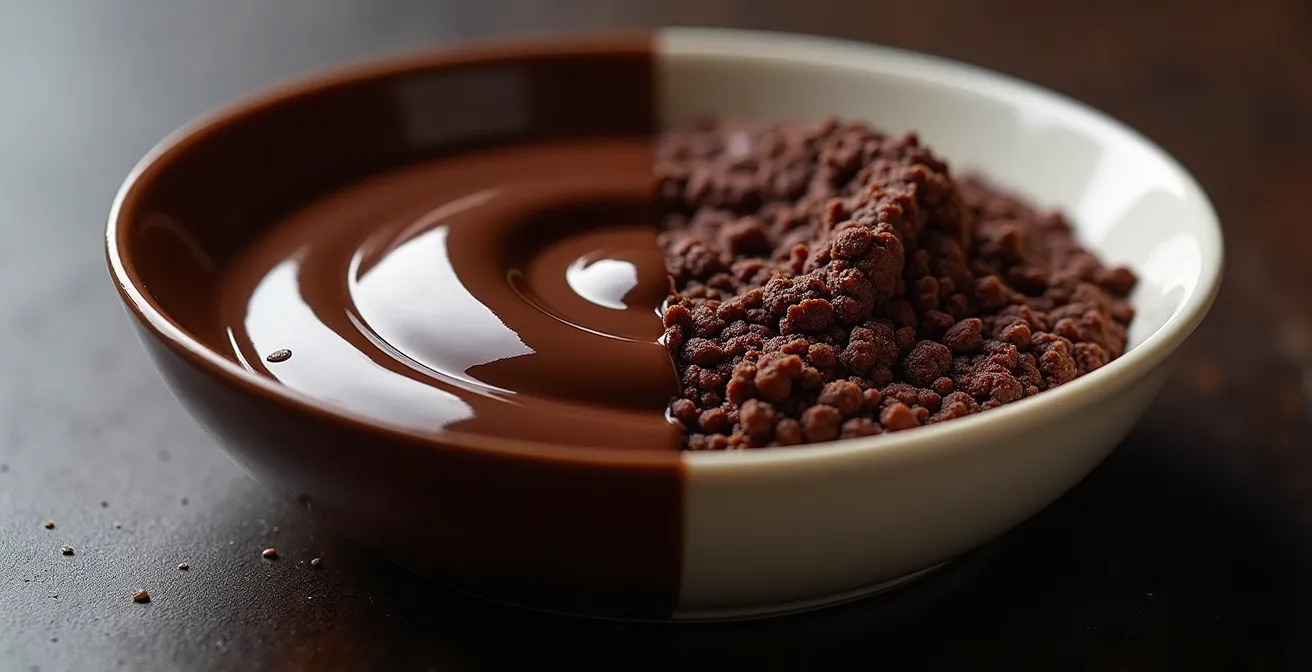
Your ganache failure isn’t a skill issue; it’s a chemistry problem caused by using the wrong type of fat.
- Supermarket chocolate chips contain added vegetable fats and stabilizers that actively disrupt the fragile chocolate-and-cream emulsion required for a silky ganache.
- Couverture’s high, pure cocoa butter content is the key to creating a stable, predictable, and luxuriously smooth structure that melts perfectly.
Recommendation: To guarantee success, always choose couverture chocolate and pay attention to its cocoa butter percentage (fluidity), not just its cocoa solids percentage, for consistent, professional results.
There’s a heart-sinking moment every baker knows. You’re creating a ganache, and the glossy, unified river of chocolate and cream suddenly breaks. It transforms into a greasy, grainy, curdled mess. You retrace your steps: was the cream too hot? Did I stir it wrong? You’ve probably been told to simply use “better quality” chocolate, a piece of advice as vague as it is unhelpful. The common wisdom points to technique, but the real culprit is often hidden at a molecular level.
But what if the problem isn’t your technique, but the very physics of the ingredients you’re using? The failure of your ganache is not a baking error; it’s a broken emulsion. An emulsion is a delicate mixture of two liquids that don’t normally combine, in this case, the fat from the chocolate and the water from the cream. The difference between a silky truffle center and an oily slick lies in the molecular battle between the pure cocoa butter found in couverture and the cocktail of competitive fats and stabilizers engineered into supermarket chocolate chips.
This isn’t just about taste or brand names; it’s about food science. Understanding this fundamental difference is the key to moving from frustrating failures to consistent, professional-grade results. We’re not just melting chocolate; we are building a stable fat-in-water structure. This guide will dissect the science, explain why those chips are designed to fail in a ganache, and provide the practical knowledge to choose and handle couverture like a seasoned pastry chef.
This article will guide you through the critical technical differences between chocolate types and provide actionable solutions for common chocolate-work challenges. Explore the sections below to master the science behind perfect chocolate creations.
Table of Contents: The Pastry Chef’s Guide to Perfect Ganache
- How to Choose the Right Fluidity Percentage for Dipping Strawberries?
- Is Valrhona Worth 3x the Price of Callebaut for a Birthday Cake?
- How to Handle Couverture in Summer Without a Climate-Controlled Kitchen?
- The Texture Disaster of Swapping 55% for 70% Couverture in Mousse
- How Long Does Open Couverture Last Before Losing Its Tempering Properties?
- Butter or Glucose: Which Ingredient Best Improves the Melt-in-Mouth Sensation?
- How to Coat Hazelnuts in Caramel Without Them Clumping Together?
- How to Fix a Broken Ganache That Looks Oily and Curdled?
How to Choose the Right Fluidity Percentage for Dipping Strawberries?
The term “fluidity” in couverture is a direct measure of its cocoa butter content and is arguably more important than the cocoa percentage for applications like coating. A higher fluidity (more cocoa butter) results in a thinner, more liquid chocolate when melted, creating a delicate, crisp shell. A lower fluidity creates a thicker coating. For dipping strawberries, you want a shell that provides a satisfying “snap” without being overly thick or heavy. The goal is to complement the fruit, not overwhelm it.
For this specific application, you are looking for a medium-fluidity chocolate. According to industry experts, professional chocolatiers recommend couverture with 31-39% cocoa butter content for coating and enrobing. This range, often indicated by a “drop” rating system on the packaging (typically 3 out of 5 drops), provides the ideal viscosity. It’s fluid enough to create a thin, even layer that clings to the strawberry’s surface but viscous enough that it doesn’t all run off before setting.
If you’re unsure of your chocolate’s fluidity, you can perform a simple test at home to gauge its behavior before committing your entire batch of fruit. This small step can save you from a disappointing outcome.
- Step 1: Heat your couverture to its working temperature (typically 88-90°F / 31-32°C). Conduct a “drip test” by lifting a spoonful and counting the drops per second. A count of 3-4 drops indicates a medium fluidity, which is ideal for strawberries.
- Step 2: Test the coating thickness by dipping a cold spoon and measuring the shell’s thickness after 30 seconds of setting. You should aim for a 1-2mm shell for an optimal snap without adding excessive weight.
- Step 3: If the chocolate is too thick, you can adjust its fluidity. Add pure cocoa butter in small increments (starting with 1% of the total chocolate weight) to make it thinner. If it’s too thin, blend it with a lower-fluidity chocolate to thicken it.
Is Valrhona Worth 3x the Price of Callebaut for a Birthday Cake?
The debate between premium brands like Valrhona and workhorse brands like Callebaut is not just about price; it’s about application. Deciding whether the significant cost increase is justified depends entirely on where the chocolate will be used in your cake. In some cases, using a premium chocolate is essential for flavor and texture, while in others, its nuanced notes will be completely lost, making the extra expense pointless. Market trends show a widening gap, with a 17% price increase for branded chocolate in 2024, making this decision even more critical for your budget.
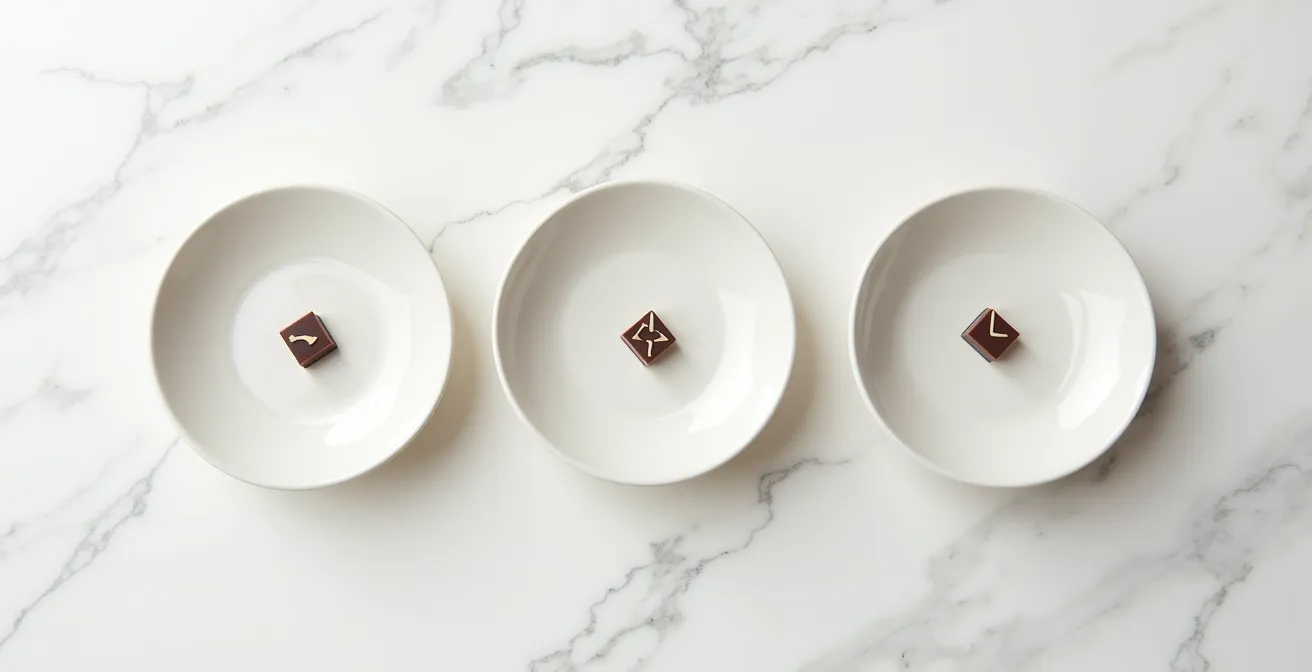
The key is to think like a pastry chef: use the best ingredient where it will shine the most. A blind taste test often reveals that in complex mixtures, the subtleties of an expensive chocolate are masked. For a birthday cake, which has multiple components, a strategic approach is best. The most perceptible difference will be in applications where the chocolate is the star.
This comparative analysis, based on common professional use cases, breaks down where the premium investment pays off. In applications with high dilution from other ingredients like flour and sugar, the nuanced flavor profile of a premium chocolate is lost, making a standard couverture not only sufficient but also more economical.
| Application | Worth Premium Cost | Standard Sufficient | Perceptible Difference |
|---|---|---|---|
| Pure Ganache Center | Yes | No | High – Direct flavor impact |
| Buttercream Base | Maybe | Yes | Medium – Masked by butter/sugar |
| Cake Batter Inclusion | No | Yes | Low – Diluted by other ingredients |
| Mirror Glaze | Yes | No | High – Flavor and finish critical |
How to Handle Couverture in Summer Without a Climate-Controlled Kitchen?
Working with couverture chocolate in high heat and humidity is one of the greatest challenges for a home baker. Summer kitchens can easily reach temperatures that are hostile to the stable Form V fat crystals required for a good temper. When ambient temperatures rise above 75°F (24°C), traditional tempering methods become a race against time, as the chocolate struggles to cool and set properly. Humidity is another enemy, as it can cause sugar bloom, a gritty texture on the chocolate’s surface. However, with the right techniques and a bit of ingenuity, it’s possible to achieve a perfect temper even without professional equipment.
Professional Mycryo Seeding Technique for High Temperatures
One advanced technique used by professionals in warm environments involves using Mycryo, which is powdered cocoa butter. As demonstrated in a professional pastry chef’s video on tempering chocolate, this method provides a much wider working window. In ambient temperatures of 75-85°F (24-29°C) with 60-75% humidity, using Mycryo at 1% of the chocolate’s weight can extend the working time to 5-7 minutes, compared to just 2-3 minutes with traditional seeding. The process involves melting the chocolate to 113°F (45°C), letting it cool to 95°F (35°C), and then stirring in the Mycryo until the working temperature of 88-90°F (31-32°C) is reached. This creates an instant, stable crystal structure that is more resilient to warm conditions.
If you don’t have access to Mycryo, you can create a makeshift controlled environment for your chocolate to set. The goal is to create a cool, dry space that mimics the conditions of a professional’s “chocolate cave.” This doesn’t have to be complicated and can be built with common household items.
Your Action Plan: DIY Cooling Cave Construction
- Create Base: Use a large cooler or an insulated box with a tight-fitting lid to form the main chamber.
- Temperature Control: Place two or three frozen gel packs wrapped in towels at the corners. The towels are crucial to prevent direct contact with the chocolate, which would cause it to set too quickly and unevenly.
- Humidity Management: Add a small, open container filled with silica gel packets or uncooked rice. These will act as a desiccant, absorbing excess moisture from the air inside the cooler.
- Monitoring: Insert a digital hygrometer to monitor the environment. You are aiming to maintain a temperature between 55-65°F (13-18°C) and a relative humidity below 60%.
- Rotation System: During the setting phase, rotate the position of your chocolate creations every 5 minutes to ensure they cool evenly and develop a consistent, glossy sheen.
The Texture Disaster of Swapping 55% for 70% Couverture in Mousse
It seems like a simple upgrade: swapping a 55% dark chocolate for a more intense 70% to create a richer mousse. However, this common substitution often leads to a texture disaster—a mousse that is dense, grainy, or even splits. The reason is not a matter of “quality” but of simple math and chemistry. The percentage on a chocolate bar refers to the total cocoa solids (cocoa mass + added cocoa butter). As this percentage increases, the amount of sugar decreases, but more importantly, the ratio of fat (cocoa butter) to non-fat cocoa solids changes dramatically. A 70% chocolate has significantly more non-fat solids, which absorb moisture, and often a different fat percentage than a 55% chocolate.
This shift fundamentally alters the balance of your ganache or mousse base. Research shows that moving from a 55% to a 70% chocolate can result in a 15% increase in non-fat cocoa solids. These solids act like tiny sponges, soaking up the water from the cream and leaving insufficient liquid to maintain a stable emulsion with the fat. The result is a mixture that is much thicker and prone to breaking or becoming grainy when folded into egg whites or whipped cream.
To successfully use a higher percentage chocolate, you must rebalance the recipe by adjusting the amount of liquid (cream) or fat (butter). This isn’t guesswork; it’s a formulaic adjustment. Pastry chefs use specific ratios to compensate for the varying properties of different chocolates.
As pastry chef Matt Adlard explains, rescuing a mousse made with the wrong ratio is possible but requires a gentle hand. He notes the secret is to re-establish the emulsion without destroying the airy texture.
The key to rescuing a failed 70% mousse is gentle reheating to 95°F while slowly incorporating warm cream in tablespoon increments, using an immersion blender to re-emulsify without incorporating air.
– Matt Adlard, Pastry Chef, Chocolate Ganache Guide
The following table provides a clear guide on how to adjust your ganache ratios to achieve the desired texture, preventing a disaster before it happens.
| Chocolate % | Chocolate:Cream Ratio | Additional Butter | Result Texture |
|---|---|---|---|
| 55% Cocoa | 1:1 | None | Silky, light |
| 60% Cocoa | 1.2:1 | 5% of cream weight | Smooth, medium body |
| 70% Cocoa | 1.5:1 | 10% of cream weight | Rich, stable |
| 85% Cocoa | 2:1 | 15% of cream weight | Dense, intense |
How Long Does Open Couverture Last Before Losing Its Tempering Properties?
Couverture chocolate, unlike a candy bar, is a semi-finished product prized for a very specific quality: its temperability. This ability comes from a precise crystal structure within its cocoa butter, known as Form V crystals. When you open a bag of couverture, you expose it to its three main enemies: heat, light, and air. Over time, these elements can degrade the delicate crystal structure, making the chocolate progressively more difficult, or even impossible, to temper correctly. While the chocolate may still be perfectly fine to eat or use in a batter, its ability to create a glossy, snappy shell will diminish.
The lifespan of open couverture is not about flavor spoilage but about the degradation of these crucial fat crystals. Once this structure is compromised, the chocolate is more likely to “bloom,” where fat or sugar separates and rises to the surface, creating a dusty or streaky appearance.
Form V Crystal Degradation Timeline Study
Testing by food scientists reveals the critical role of storage conditions. Properly stored couverture, kept in a cool, dark place between 60-65°F (15-18°C) in a sealed container, maintains its stable Form V crystals for 6-8 months after being opened. However, as noted in a detailed analysis of the science behind tempering chocolate, even brief temperature fluctuations above 75°F (24°C) can start to degrade this crystal structure within just 2-3 weeks. This makes subsequent tempering attempts progressively more difficult, often requiring the addition of 20-30% fresh, unopened couverture (a technique called “seeding”) to reintroduce a sufficient amount of stable crystals for a successful temper.
If your chocolate has been open for a while and you’re unsure of its condition, you can perform a quick visual diagnosis to determine the type of bloom and whether it’s salvageable for tempering work.
- Fat Bloom Test: Gently warm a small spot on the surface with a hairdryer on low heat. If the whitish coating disappears and melts back into the chocolate, it’s fat bloom. This is often salvageable for tempering.
- Sugar Bloom Test: Touch the surface with a dry finger. If it feels gritty, rough, and the bloom doesn’t disappear with gentle warmth, it’s likely sugar bloom caused by moisture. This chocolate is generally not salvageable for tempering but can be used in baked goods.
- Reset Protocol for Fat Bloom: To rescue chocolate with fat bloom, you must fully melt it to 122°F (50°C) to dissolve all existing unstable crystals. Then, proceed with tempering, ideally by seeding with at least 20% fresh couverture.
- Storage Fix: To prevent bloom, wrap opened chocolate first in parchment paper, then in foil, and finally store it in an airtight container with a silica packet to absorb any moisture.
Butter or Glucose: Which Ingredient Best Improves the Melt-in-Mouth Sensation?
Creating a ganache with a luxurious, melt-in-the-mouth texture often involves adding ingredients beyond just chocolate and cream. The two most common additions are butter and glucose syrup, and while both can improve the final product, they function in fundamentally different ways and are suited for different applications. The choice between them depends on the specific textural and shelf-life properties you want to achieve. Butter adds richness and affects the melting point, while glucose controls moisture and provides stability.
Adding a small amount of softened butter to a ganache at the end of the emulsification process enriches the flavor and lowers the melting point. Because butter melts at body temperature, it contributes to that classic, sharp “melt-in-your-mouth” sensation, particularly desirable in truffle centers. However, it also shortens the ganache’s shelf life. Glucose syrup, on the other hand, is an invert sugar that acts as a powerful texture stabilizer and humectant.
As explained by baking experts, glucose’s primary role is to manage water, which in turn extends shelf life and creates a uniquely smooth texture.
Glucose syrup acts as a powerful humectant, binding 20% more moisture than sugar alone, preventing crystallization and extending ganache shelf life by up to 40% while creating a smoother, more lingering melt.
– Cakes by MK Professional Baking, Chocolate Ganache Complete Guide
The best choice depends on your goal. For a quick, rich truffle filling, butter is excellent. For a stable bonbon filling or a glossy cake glaze that needs to hold for several days, glucose is superior. In many professional settings, a combination of both is used to get the best of both worlds: a rich mouthfeel from the butter and the stability and smooth texture from the glucose. This matrix helps clarify which ingredient to use based on the desired outcome.
| Application | Butter Addition | Glucose Addition | Combined Effect |
|---|---|---|---|
| Truffle Center | Sharp melt at 32°C, rich flavor | Slow melt, chewy texture | Balanced melt, extended flavor release |
| Cake Glaze | Soft set, prone to fingerprints | Firm, glossy, stable | Professional finish with depth |
| Whipped Ganache | Light, airy, short shelf life | Dense, stable, extended life | Mousse-like with 5-day stability |
| Bonbon Filling | Luxurious mouthfeel, 7-day life | Firm bite, 14-day life | Premium texture, 10-day life |
How to Coat Hazelnuts in Caramel Without Them Clumping Together?
Creating perfectly separate, individually caramel-coated nuts (a process known as panning or “praline”) is a classic confectionery challenge. The common frustration is a sticky, solid mass of nuts clumped together by a thick, uneven layer of caramel. The secret to avoiding this lies in controlling two key variables: temperature differential and the application method. You cannot simply pour hot caramel over nuts and expect a good result. The process is about building up many micro-thin layers of caramel, allowing each to cool and crystallize slightly before adding the next.
Professional Panning Technique for the Home Kitchen
Professional confectioners use large, rotating panning machines, but the principle can be adapted for home use. The key is maintaining a significant temperature difference between the nuts and the caramel. According to professional guides on sugar work, confectioners maintain the caramel at a precise 320°F (160°C) while the toasted nuts are held at around 200°F (93°C). The technique involves adding only a small amount of the hot syrup to the warm nuts in a tilted metal bowl, then tossing and rotating continuously for about 30 seconds. This builds one thin, almost invisible coat. The process is repeated, adding small portions of caramel sequentially to build up 4-5 thin layers instead of one thick one, which is the primary cause of clumping.
Another critical factor is preventing the sugar in your caramel from crystallizing prematurely, which can turn your smooth syrup into a grainy mess. This is achieved by using “doctor ingredients”—substances that interfere with the formation of large sugar crystals. Constant motion is also essential to distribute the caramel evenly and keep the nuts from sticking to one another as they cool.
- Use Doctor Ingredients: Add 2 tablespoons of glucose syrup or corn syrup for every cup of sugar. This disrupts the sucrose chains and prevents large crystals from forming. A tiny pinch (1/4 teaspoon) of an acid like cream of tartar or lemon juice also helps.
- Maintain Constant Motion: Once you add the nuts to the caramel, you must keep them moving. Use a silicone spatula to stir in a figure-8 pattern, ensuring all nuts are coated and separated.
- Work in Small Batches: Don’t overcrowd your pan. Work with a maximum of 2 cups of nuts per batch of caramel to ensure you have enough space to keep them moving and separated.
- Cool on a Prepared Surface: Immediately turn the coated nuts out onto a silicone mat or parchment paper that has been lightly dusted with cornstarch. The cornstarch will absorb any residual stickiness and prevent the nuts from fusing together as they cool completely.
Key Takeaways
- A ganache is a fat-in-water emulsion; its stability depends entirely on the percentage and purity of cocoa butter, not just vague “quality.”
- Supermarket chips are engineered with added vegetable fats and stabilizers that actively compete with cocoa butter, disrupting the emulsion and causing a grainy or oily texture.
- Always rebalance your cream-to-chocolate ratio when changing the cocoa percentage. Higher percentages require more liquid or fat to maintain a stable emulsion.
How to Fix a Broken Ganache That Looks Oily and Curdled?
A broken ganache, with its telltale oily sheen and grainy texture, is the physical manifestation of a failed emulsion. The fat (from the cocoa butter and cream) has separated from the water (from the cream), and no amount of simple whisking seems to bring them back together. The good news is that in most cases, a broken ganache is completely salvageable. The solution isn’t to add more ingredients randomly, but to use mechanical force to break the fat droplets down into particles small enough to be suspended in the water again, thus re-forming the emulsion.
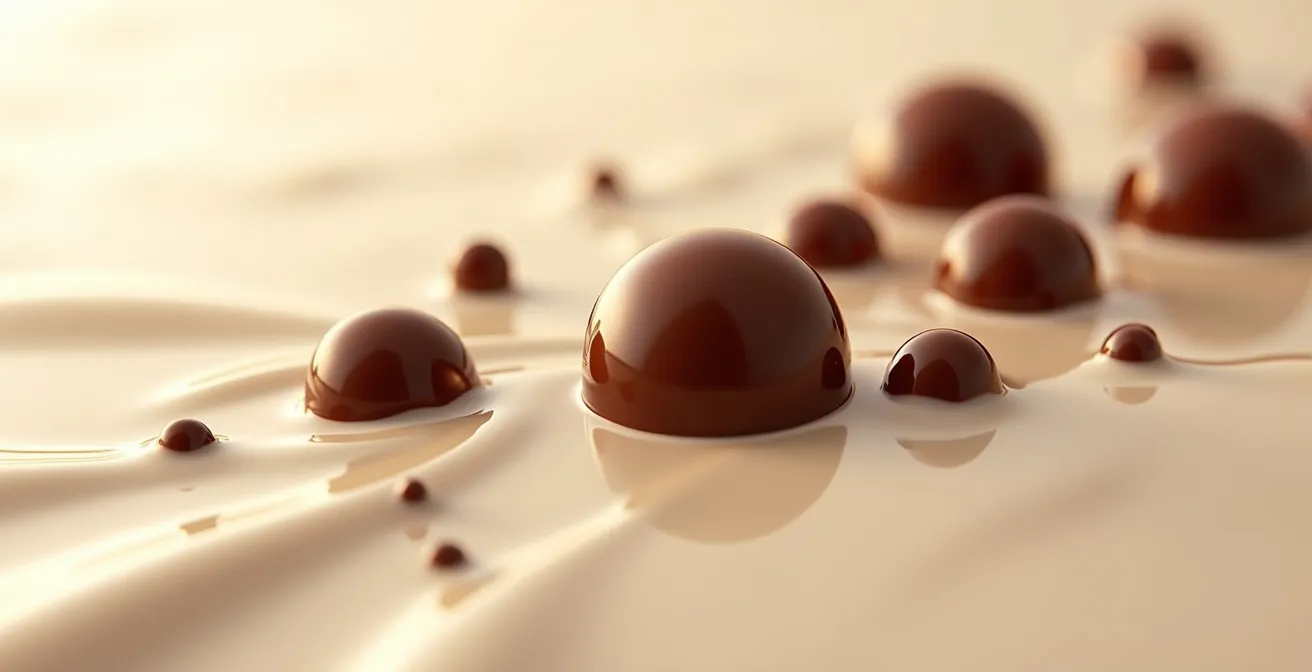
The most effective tool for this is not a whisk, but an immersion blender. As explained by pastry experts, the mechanics of fixing a ganache are about brute force on a microscopic level.
A broken ganache is essentially a failed emulsion where fat droplets have separated from the water phase. The immersion blender creates shear forces 10 times stronger than whisking, forcing droplets back into suspension within 30-60 seconds.
– Olivia from Liv for Cake, How To Make Ganache Guide
To fix the ganache, gently warm it over a double boiler to about 90-95°F (32-35°C) — just enough to make it fluid but not hot. Then, add a tablespoon of warm milk or cream to introduce a bit more water. Submerge the head of the immersion blender completely, keeping it at the bottom of the bowl to avoid incorporating air, and pulse it. You will see the ganache almost magically come back together into a smooth, glossy state.
Of course, prevention is always better than a cure. The “reverse ganache method” is a technique that dramatically reduces the risk of splitting by creating a more stable foundation for the emulsion from the very beginning.
- Start with a Stable Foundation: Place your solid, finely chopped chocolate in a bowl. This provides a stable crystal structure to start with.
- Pour Hot Cream Centrally: Heat your cream to just below a boil (180-190°F or 82-88°C) and pour it in a thin, steady stream directly into the center of the chopped chocolate.
- Let it Rest (Thermal Equilibrium): Do not stir. Let the mixture sit undisturbed for 2 full minutes. This allows the heat to transfer evenly and melt the chocolate gently without thermal shock.
- Emulsify from the Center Out: Using a spatula, begin stirring in very small, tight circles in the absolute center of the bowl. A smooth, glossy emulsion will form in the middle. Gradually widen your circles, incorporating more of the surrounding mixture until the entire ganache is smooth and unified. This method reduces the risk of splitting by an estimated 80% compared to traditional stirring.
Now that you understand the science, stop guessing and start engineering your ganache for success. Apply these principles of emulsion and ingredient selection to your next batch and see the profound difference that food science can make in your baking.