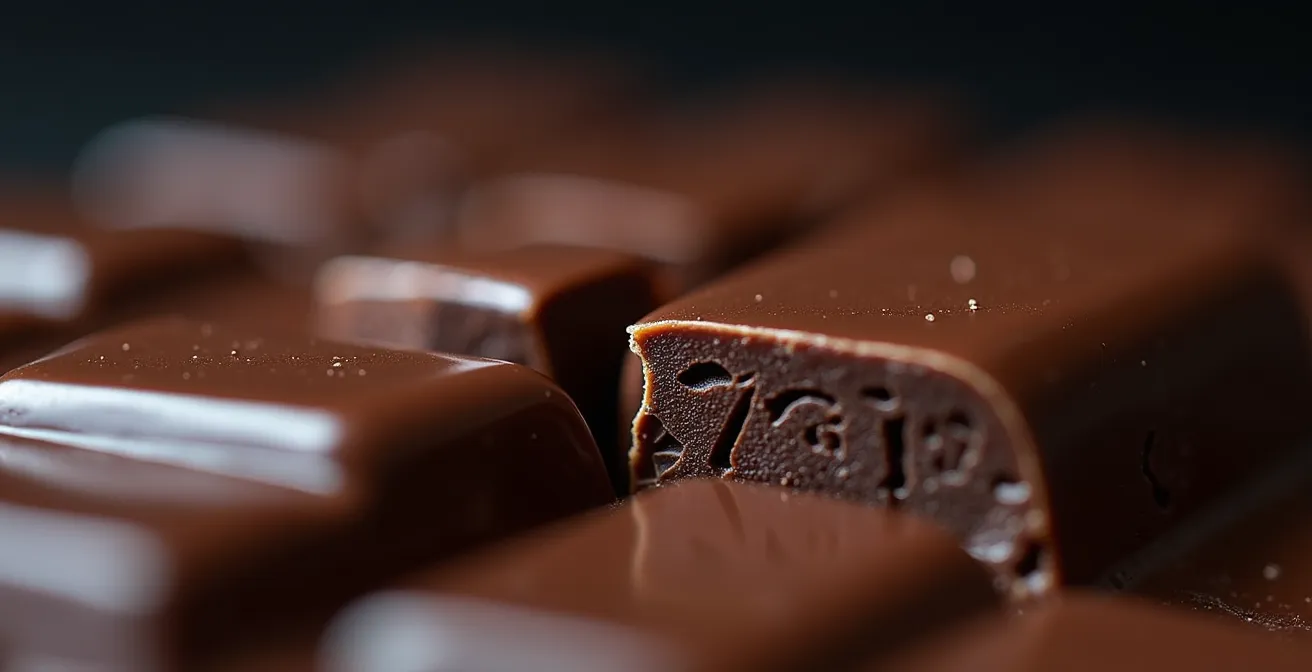
The satisfying ‘snap’ of a chocolate bar is not merely a sign of quality; it’s an auditory trigger that actively manipulates your brain’s perception of its taste.
- Sound and texture are not separate from flavor; they are integral components of the gustatory experience constructed by the brain through a process called cross-modal perception.
- From the chocolate’s molecular structure (Beta-V crystals) to the weight of your cutlery, every sensory input is a piece of data that pre-programs how you will perceive its richness and quality.
Recommendation: To truly understand taste, one must analyze the complete sensory journey—the sounds, sights, and tactile sensations—not just the chemical compounds on the tongue.
We’ve all been told that the sharp, crisp ‘snap’ of a chocolate bar is the hallmark of high quality. It’s a simple rule of thumb, an auditory shortcut to assess what we’re about to eat. But this common wisdom barely scratches the surface of a much more fascinating phenomenon. The experience of flavor is not a simple input-output process confined to our taste buds. It’s a complex, multi-sensory illusion actively constructed by our brain, and sound is one of its most powerful co-conspirators.
As a psychology student, you understand that perception is malleable. In the world of food science, we don’t just create flavors; we engineer experiences. From a psychoacoustic standpoint, the ‘snap’ is more than a characteristic—it’s auditory foreshadowing. It sends a signal to the brain, setting expectations for a firm, non-waxy texture and a clean melt. But what if the sound is wrong? What about a gritty texture, a surprising ‘pop’, or the clink of a spoon against a bowl? These are not trivial details; they are critical data points in the cognitive equation of taste.
This article moves beyond the platitude that “snap means good.” Instead, we will deconstruct the sensory mechanisms at play. We will explore how texture, from the molecular level to the macrostructure of a bonbon, generates specific auditory cues. We will examine how the brain processes these sounds in conjunction with visual and tactile information to build a coherent, and often enhanced, perception of flavor. This is a journey into the science of cross-modal perception, where a sound can genuinely make chocolate taste better.
To fully grasp how these sensory inputs are engineered and interpreted, we will delve into the specific principles that govern the chocolate experience. This guide breaks down the key auditory and textural components, from the most undesirable sensations to the most artfully crafted surprises.
Summary: Deconstructing the Auditory Experience of Chocolate
- Why Is ‘Gritty’ the Most Hated Texture in Chocolate?
- How to Use Popping Candy in Chocolate Without It Popping Prematurely?
- Matte vs. Mirror Shine: Which Visual Texture Triggers Hunger More?
- The Shell Thickness Mistake That Makes Bonbons Unpleasant to Chew
- What Weight of Cutlery Enhances the Perception of Quality in Desserts?
- Why Is Beta-Crystal Formation Crucial for the Snap of Your Bar?
- Why Does Hidden Popping Candy Create an Emotional Reaction?
- How to Write Chocolate Descriptions That Increase Sales by 20%?
Why Is ‘Gritty’ the Most Hated Texture in Chocolate?
Before we explore pleasant sounds, we must first understand their antithesis: the grating sensation of a poorly made chocolate. The experience of ‘grittiness’ is a fundamental failure in textural and, by extension, auditory congruence. Our brains are wired to expect a smooth, velvety mouthfeel from chocolate. When we encounter a sandy, granular texture, it creates a sensory dissonance that signals a low-quality product. This isn’t just a matter of preference; it’s a psycho-physical reaction to a structural flaw.
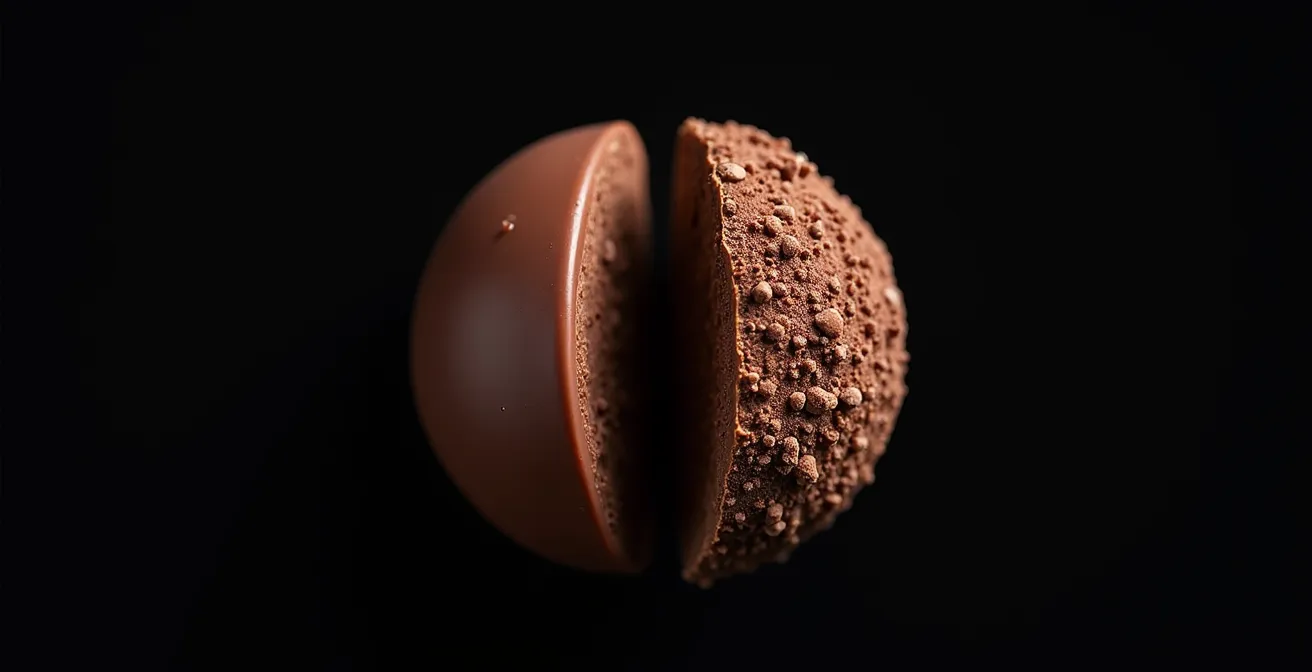
This unwanted texture arises from two primary sources: improper ‘conching’ (a process of refining and smoothing chocolate) or ‘fat bloom’ caused by unstable crystal formation. During conching, cocoa and sugar particles are ground down to a size below what the human tongue can perceive, typically under 20 microns. If particles are too large, they are detected as individual grains, creating the dreaded gritty sensation. The illustration below contrasts a smooth, well-refined surface with a granular one, showing how particle size is the foundation of mouthfeel.
Similarly, when chocolate is not tempered correctly, the cocoa butter forms unstable crystal structures. These larger, irregular crystals can migrate to the surface, creating a dusty appearance and a rough, waxy, or gritty mouthfeel. This textural defect completely undermines the anticipated pleasure. Well-tempered chocolate, with its stable beta-V crystals, ensures a uniform structure that melts smoothly and consistently, preventing the unpleasant grittiness associated with unstable crystal formations. It’s the first step in creating a predictable and enjoyable sensory journey.
How to Use Popping Candy in Chocolate Without It Popping Prematurely?
Introducing a deliberate, surprising sound into chocolate, like popping candy, is a powerful tool for creating a memorable and playful experience. However, the success of this technique hinges entirely on control. Popping candy (or carbonated candy) is made by trapping pressurized carbon dioxide gas inside small sugar crystals. Its magic is activated by moisture; when saliva dissolves the sugar shell, the gas is released with an audible pop and crackle. This creates a significant challenge for chocolatiers, as chocolate contains small amounts of water and fat that can prematurely trigger the reaction.
The primary goal is to create a barrier between the candy and any moisture in the chocolate. The most effective method involves encapsulating the popping candy in an anhydrous (water-free) fat before incorporating it. Pure, melted cocoa butter is the ideal material for this task. It forms a protective shell that only melts in the mouth, ensuring the ‘pop’ occurs precisely when intended, delivering that burst of sensory surprise. Timing and temperature are also critical. For instance, professional chocolatiers maintain that working with dark chocolate at its tempering temperature of around 29-30°C (84-86°F) ensures the chocolate is fluid enough for mixing but cool enough to minimize premature melting of the cocoa butter coating.
Mastering this technique requires a systematic approach to ensure the integrity of the popping candy is preserved until the moment of consumption. The following plan outlines the professional methodology for successfully incorporating this volatile ingredient.
Action Plan: Preserving the Pop in Chocolate
- Pre-coat popping candy with pure, melted cocoa butter (an anhydrous fat) to create a robust moisture barrier.
- Allow the chocolate to cool to its ideal working temperature (e.g., just above solidification at 29-30°C for dark chocolate).
- Gently fold the coated candy into the tempered chocolate only when the chocolate has reached this optimal working temperature.
- Work quickly to mold or shape the chocolate, minimizing the time the candy is suspended in the liquid state.
- Always test a small batch to verify the integrity of the coating and the intensity of the ‘pop’ before proceeding with full production.
Matte vs. Mirror Shine: Which Visual Texture Triggers Hunger More?
Long before a sound is made or a texture is felt, our perception of chocolate begins with our eyes. Visual cues are the first stage of auditory foreshadowing, setting powerful expectations about the subsequent sensory experience. The shine on a piece of chocolate is a primary indicator of its quality and anticipated mouthfeel. A high-gloss, mirror-like shine is almost universally perceived as more appealing and hunger-inducing than a dull, matte finish.
From a psychological perspective, this preference is deeply rooted in our cognitive associations. A brilliant shine is the visual signature of excellent tempering. It tells our brain that the chocolate has a tight, stable beta-V crystal structure. This visual information allows us to subconsciously predict the physical sensations to come: a clean, sharp ‘snap’ when broken, a firm texture in the mouth, and a smooth, even melt. The glossiness acts as a promise of a high-quality haptic and auditory experience. It signals freshness, expert craftsmanship, and a high cocoa butter content, all of which are proxies for superior flavor.
Conversely, a matte, dull, or streaky surface often indicates poor tempering, fat bloom, or sugar bloom. Our brain interprets these visual imperfections as warning signs. A matte finish suggests a potentially crumbly or waxy texture, an absence of a satisfying snap, and a gritty or cloying mouthfeel. This visual-gustatory dissonance lowers our expectations and can even suppress appetite. Therefore, the mirror shine consistently triggers a stronger hunger response because it aligns perfectly with our learned expectations of what a premium chocolate experience should look, feel, and sound like.
The Shell Thickness Mistake That Makes Bonbons Unpleasant to Chew
The pleasure derived from a filled bonbon is a carefully choreographed, two-part sensory event. It’s not just about the flavor of the filling but the mechanical and auditory experience of breaking through the shell. A common mistake in bonbon creation is a uniform, overly thick shell. This creates a monotonous and often strenuous chewing experience. The ideal bonbon doesn’t just have a shell; it has an engineered structure designed to fracture in a specific way, generating a satisfying sound and texture contrast.
Research from industry experts reveals the importance of variable thickness. As the Giapo Chocolate Research Team notes, a structure with a thicker base and thinner top and side walls is optimal. This design creates a “two-stage sensory event where teeth first meet minimal resistance, then a satisfying ‘crack’ is generated from the base.” The initial, easy break through the thin top provides a moment of anticipation, followed by the rewarding, high-frequency crack from the thicker, more robust base. This contrast is far more pleasing than the dull, low-frequency crunch of a uniformly thick shell.
The ideal ratio of shell to filling is therefore not just a matter of taste but of structural mechanics. A shell that is too thick relative to the filling overpowers the delicate ganache or caramel inside, while one that is too thin fails to provide a satisfying snap. The following table, based on an analysis of chocolate science, outlines optimal ratios for different bonbon types to achieve the perfect balance of sound and texture.
| Bonbon Type | Shell Thickness | Ideal Ratio | Consumption Method |
|---|---|---|---|
| Small Round | 1-2mm | 1:4 | Whole consumption |
| Large Flat | 2-3mm | 1:3 | Bitten in half |
| Filled Bars | 3-4mm base, 2mm walls | 1:2.5 | Sectioned bites |
What Weight of Cutlery Enhances the Perception of Quality in Desserts?
The principles of cross-modal perception extend beyond the food itself to the tools we use to consume it. The brain doesn’t isolate the taste of the chocolate from the feeling of the spoon in your hand; it integrates all sensory inputs into a single, unified experience. Research has consistently shown that the weight, material, and even color of cutlery can significantly alter our perception of food’s quality, density, and flavor.
This phenomenon is known as sensation transference, where the physical attributes of the serving-ware are unconsciously transferred to the food itself. A heavier spoon, for example, makes a dessert seem more substantial, dense, and luxurious. The brain makes a simple cognitive leap: “heavy spoon” equals “heavy,” “rich,” or “high-quality” dessert. Conversely, eating the exact same dessert with a flimsy plastic spoon can make it seem cheaper, less satisfying, and less flavorful. This is a powerful demonstration of how tactile cues pre-program our gustatory expectations.
Case Study: The Influence of Utensil Weight on Chocolate Perception
In a study on cross-modal perception, researchers at Washington State University investigated how tactile elements influence the sensory experience of chocolate. They found that the weight and material of cutlery create what is known as ‘expectation congruence.’ Participants tasting rich, dense chocolate desserts rated them as higher in quality and more enjoyable when using heavy, metal utensils compared to lightweight plastic ones. The heavy cutlery enhanced the perception of richness and density, aligning with the inherent qualities of the dessert. In contrast, lighter utensils were found to amplify the perception of ‘airiness’ in foods like mousse, demonstrating that the ideal cutlery weight is context-dependent and should match the food’s texture.
For a psychology student, this is a classic example of embodied cognition. The physical interaction with the spoon provides a framework through which the brain interprets the signals from the tongue. Therefore, to truly elevate a chocolate dessert, one must consider not just the recipe but also the weight and material of the cutlery, as it is an active participant in the creation of flavor.
Why Is Beta-Crystal Formation Crucial for the Snap of Your Bar?
We finally arrive at the molecular heart of our central question: the ‘snap’. This iconic sound is not an accident; it is the direct, audible result of a precise crystalline structure within the cocoa butter. Cocoa butter is polymorphic, meaning it can crystallize into six different forms (labeled I through VI). Of these, only one—the Beta-V crystal—produces the desirable qualities of a high-end chocolate: a glossy shine, a smooth mouthfeel, and, most importantly, a sharp, clean snap.
The process of ‘tempering’ is the art of encouraging the cocoa butter to form these specific Beta-V crystals. It involves a meticulous cycle of heating, cooling, and agitating the chocolate to precise temperatures, such as around 32.8°C (91°F) for dark chocolate, to promote the formation of these stable crystals while eliminating the unstable ones. When chocolate is properly tempered, these tiny, uniform Beta-V crystals pack together in a very tight, orderly, and brittle lattice structure.
The ‘snap’ is the sound of energy being released as a fracture propagates rapidly and cleanly through this rigid crystal matrix. As the celebrated food scientist Alton Brown explains, the physics of the sound are a direct consequence of this microscopic arrangement.
Beta-V crystals are small, tightly packed, and uniform, allowing a fracture to propagate cleanly and rapidly across the structure, creating a high-frequency, brittle ‘snap’
– Alton Brown, How and Why to Temper Chocolate
In contrast, untempered chocolate is dominated by larger, unstable crystal forms. These form a soft, weak structure that doesn’t break cleanly. Instead, it crumbles or bends with a dull, low-frequency thud. The sound of the snap is, therefore, the most reliable and immediate indicator that the chocolate possesses the correct internal architecture for a superior sensory experience.
Why Does Hidden Popping Candy Create an Emotional Reaction?
The effect of popping candy goes beyond a simple, playful sound. When this sensory surprise is hidden within the smooth, predictable texture of chocolate, it can trigger a surprisingly strong emotional and physiological response. This is because the brain is not just processing a sound; it’s reacting to a sensory violation. Our cognitive framework for chocolate is built on expectations of smoothness and a consistent melt. The sudden introduction of a crackling, popping sensation is a benign and controlled violation of these expectations.
This phenomenon can be explained by the concept of ‘benign masochism,’ where humans derive pleasure from controlled, non-threatening negative experiences. Think of the thrill of a scary movie or the burn of a chili pepper. The unexpected pop of the candy creates a moment of sensory shock or confusion, which is then immediately re-contextualized by the brain as safe and enjoyable. This quick resolution from surprise to pleasure releases a small burst of dopamine, creating a memorable and highly engaging experience.
Scientific research has validated this emotional impact. In a study on sensory surprises, researchers at the University of Melbourne used biometric monitoring to track participants’ reactions to chocolate. They found that encountering hidden popping candy triggered significant changes in the autonomic nervous system. Measurable shifts in heart rate variability and facial muscle expressions were observed, providing objective evidence of an emotional response. The surprise wasn’t just ‘fun’; it was a physiological event. This demonstrates that by artfully breaking sensory expectations, we can create products that are not just tasted, but felt on an emotional level.
Key Takeaways
- The iconic ‘snap’ of chocolate is a direct auditory signal of a well-formed Beta-V crystal structure, which the brain interprets as a sign of quality and freshness.
- Cross-modal perception is key: external factors, like the weight of a spoon, are unconsciously transferred to the chocolate, altering our perception of its richness and value.
- Sensory surprises, such as hidden popping candy, can trigger a pleasurable emotional response (benign masochism) by safely violating our textural expectations.
How to Write Chocolate Descriptions That Increase Sales by 20%?
All the sensory science we’ve discussed culminates in one critical application: communication. How do you translate these complex psychoacoustic and textural experiences into words that not only describe but also persuade? The key is to write descriptions that allow the customer to mentally simulate the sensory experience before they even take a bite. This isn’t just creative writing; it’s the linguistic application of sensory science.
The most effective descriptions go beyond simple flavor notes like ‘nutty’ or ‘fruity’. They incorporate a sensory lexicon that touches on all modalities, especially sound and texture. Instead of saying a chocolate is “good,” you describe the “sharp, clean snap” it makes. You don’t just say it’s “smooth”; you evoke the “silent, velvety melt on the tongue.” This language helps the consumer pre-experience the product, building anticipation and enhancing its perceived value. Research on consumer lexicons has shown that when marketing language aligns with the consumer’s own internal sensory vocabulary, it resonates much more powerfully.
Using onomatopoeia is a particularly powerful technique. Words like ‘crack,’ ‘crunch,’ and ‘snap’ are auditory icons that directly trigger the part of the brain associated with that sound. The goal is to paint a complete sensory picture, connecting the technical qualities (like tempering) to the experiential benefits. For example, a phrase like “perfectly tempered for that signature snap” bridges the gap between craftsmanship and consumer pleasure. Follow these science-based principles to write descriptions that don’t just inform, but actively engage the customer’s imagination:
- Use onomatopoeia that mimics chocolate sounds: ‘sharp snap’, ‘clean crack’, ‘satisfying crunch’.
- Translate technical qualities into sensory benefits: ‘Forged to perfection for a distinct snap’.
- For smooth textures, emphasize the absence of sound: ‘a silent, velvety melt’.
- Reference specific quality indicators: ‘crafted for a high-gloss shine and a firm texture’.
- Connect sound to freshness perception: ‘the crisp break of freshly crafted chocolate’.
By understanding that taste is a multi-sensory construct, you can begin to analyze and design food experiences on a much deeper level. The next step is to apply these psychoacoustic principles to your own observations, decoding the subtle cues that shape our enjoyment of everything we eat.