
In summary:
- Your brain needs about 20 minutes to register fullness from fat, which is why you can eat a whole chocolate bar before feeling satisfied.
- Mindful techniques, like letting one square melt for five minutes, amplify sensory input and create satisfaction with less.
- Environmental cues, such as using individually wrapped pieces and a dedicated plate, interrupt mindless eating.
- You can retrain your palate to prefer complex, high-cocoa chocolate, moving from a passive consumer to an active connoisseur.
We’ve all been there: the empty wrapper in hand, a faint taste of chocolate on the tongue, and the lingering question, “Where did that entire bar go?” You weren’t particularly hungry, yet the automatic hand-to-mouth motion took over until nothing was left. The common advice is to fight this urge with willpower, to just “say no” or substitute with a piece of fruit. This approach frames your craving as an enemy to be defeated, a battle of restriction that often ends in failure and guilt.
But what if the goal wasn’t to fight your desire for sweets, but to fully embrace and understand it? What if true control came not from denial, but from profound, deliberate enjoyment? This is the core of mindful eating. It’s about shifting from the mindless speed of consumption to the intentional art of savoring. It’s not about eating less chocolate; it’s about getting *more* satisfaction from the chocolate you eat. This guide will teach you the science and techniques to transform your relationship with indulgent foods, starting with the biological reason you overeat and ending with a clear path to becoming a connoisseur of your own cravings.
For those who prefer a condensed visual format, this mini-meditation video offers a great introduction to the core principles of mindful eating we will be exploring.
This article will guide you through the practical steps and sensory science needed to master this approach. We will explore everything from the biological signals of satiety to the surprising influence of music on taste, providing you with a complete toolkit to enjoy every piece of chocolate, consciously and completely.
Summary: Mastering Mindful Chocolate Consumption
- Why Does High-Fat Chocolate Trigger Satiety Signals Slower than Protein?
- How to Make One Square Last 5 Minutes in Your Mouth?
- Individually Wrapped vs. Large Bar: Which Reduces Overeating?
- The ‘TV Snacking’ Mistake That Douglass Your Chocolate Intake
- When to Put Your Portion on a Plate Instead of Eating from the Bag?
- How to Use the ‘Snap, Melt, Breathe’ Technique for Proper Analysis?
- Why Does Eating Chocolate While Listening to Jazz Change the Flavor?
- How to Retrain Your Palate to Prefer 85% Cocoa Over 50% in 30 Days?
Why Does High-Fat Chocolate Trigger Satiety Signals Slower than Protein?
The core of the “20-minute rule” lies in understanding your body’s hormonal response to different foods. When you eat, your digestive system releases satiety hormones that signal to your brain that you are full. However, not all foods trigger these signals at the same speed. Protein prompts a relatively quick release of hormones like GLP-1 and Peptide YY, giving you a rapid sense of fullness. Fat, a primary component of chocolate, works differently. Its main satiety mechanism relies on the hormone cholecystokinin (CCK), which primarily acts by slowing down how fast your stomach empties.
This process is significantly slower and less direct. While the protein in a chicken breast might send a clear “I’m getting full” message within minutes, the fat in chocolate sends a more subtle, delayed signal. It can take up to 20 minutes for the full effect of this gastric braking to be perceived by your brain. This biological delay is the window in which mindless eating thrives. Your mouth tastes the pleasure, but your brain hasn’t received the “stop” signal yet, compelling you to reach for another piece.
A recent study confirms this delayed reaction. According to a 2024 study in The Journal of Physiological Sciences, the release of satiety hormones is a complex cascade. Protein triggers a direct and powerful hormonal response, whereas fat’s influence is more gradual and tied to the mechanical process of digestion. Understanding this isn’t about blaming your body; it’s about working with its natural rhythm. The key is to consciously slow down your eating to give your brain time to catch up with your stomach.
How to Make One Square Last 5 Minutes in Your Mouth?
Now that we understand the ‘why’ behind the 20-minute delay, let’s focus on the ‘how’ of slowing down. The goal is to transform a 30-second gulp into a five-minute immersive experience. This isn’t an act of deprivation; it’s an act of amplification. By giving one small square of chocolate your undivided attention, you extract more pleasure and satisfaction than you would from an entire bar eaten mindlessly. It starts by treating the chocolate not as a snack, but as an object of meditation.
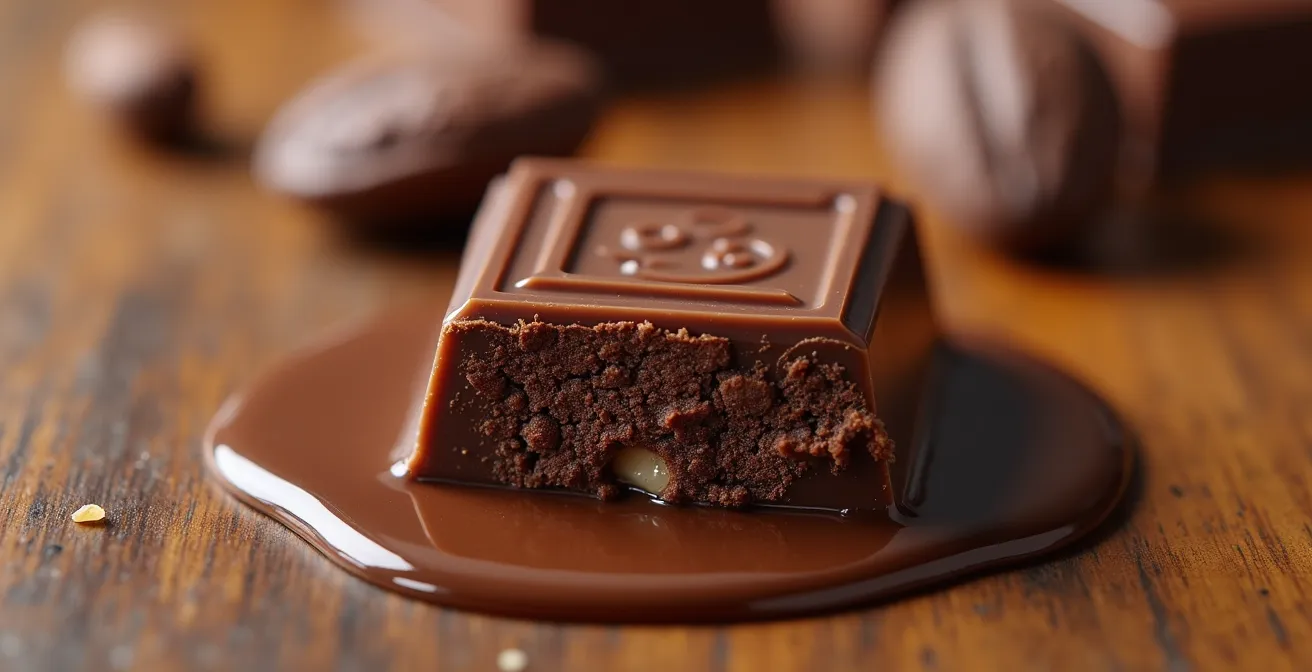
Observe the square before you even taste it. Notice its sheen, the details of its surface, and its color. Bring it to your nose and inhale its aroma. This primes your brain for the experience. Then, place it on your tongue and resist the urge to chew. Simply let it sit. Feel its texture and allow your body heat to slowly begin the melting process. As it softens, move it gently around your mouth. Notice how the flavor evolves from the initial taste to a complex bloom of secondary notes. This simple act of focusing on the sensory data—the taste, the texture, the aroma—sends a powerful stream of information to your brain, creating a sense of richness and satisfaction that chewing and swallowing quickly would completely bypass.
To structure this practice, you can follow a simple, guided meditation. The goal is to engage all your senses and stay present with the experience from start to finish.
- Settle and Observe: Close your eyes for five deep breaths. Then, open them and simply look at the chocolate, noticing its shape, color, and texture.
- Engage with Aroma: Lift the square to your nose. Inhale deeply. What do you smell? Is it fruity, earthy, roasted?
- Place, Don’t Chew: Place the chocolate on your tongue. Feel its weight and temperature. Resist the instinct to bite down immediately.
- Experience the Melt: Let the chocolate melt slowly from the warmth of your mouth. Track the changing texture from solid to liquid.
- Breathe and Taste: As it melts, breathe gently through your nose. This activates retronasal olfaction, unlocking deeper layers of flavor you would otherwise miss. Follow the taste until it completely fades.
Individually Wrapped vs. Large Bar: Which Reduces Overeating?
Your eating environment and the way food is presented have a profound impact on how much you consume. The concept of “unit bias” suggests that we perceive a single unit of something—be it a cookie, a bag of chips, or a bar of chocolate—as the appropriate amount to consume. A large, unwrapped bar presents itself as one giant unit, making it easy to continue eating without a clear stopping point. Individually wrapped pieces, however, create small, deliberate interruptions in the eating process.
Each wrapper is a micro-barrier. The physical act of unwrapping forces a pause in the automatic hand-to-mouth cycle. This pause, however brief, is a critical moment for your prefrontal cortex—the rational, decision-making part of your brain—to intervene. It’s a window of opportunity to ask yourself, “Do I truly want another?” instead of continuing on autopilot. This is not about willpower; it’s about designing your environment to support conscious choice.
The effect is surprisingly powerful. Research has shown that this simple packaging change significantly reduces consumption. In a mindless eating experiment, participants consumed 32% less chocolate when given individually wrapped pieces compared to those given a single, large unwrapped block. The extra effort and time required to unwrap each piece broke their eating momentum and increased their awareness of the quantity they were consuming. As a leading researcher in the field explains, this is a clear example of cognitive intervention.
The physical act of unwrapping breaks the automatic hand-to-mouth motion of mindless eating, giving the prefrontal cortex a crucial moment to intervene and assess true desire versus habit.
– Dr. Michael Mantzios, Journal of Cognitive Enhancement
The ‘TV Snacking’ Mistake That Douglass Your Chocolate Intake
One of the biggest culprits of mindless overeating is distraction, and the television is a master of it. When your cognitive resources are occupied by a show or movie, your brain has less capacity to process the sensory information coming from your food. This phenomenon, known as “sensory muting,” means the chocolate you’re eating literally tastes less flavorful and feels less satisfying. Because the pleasure feedback is dulled, your brain prompts you to eat more to achieve the same level of reward you would get from a smaller amount in a distraction-free setting.

Researchers have demonstrated this effect clearly. In one study, participants watched a neutral video while being given a large bowl of M&Ms. Those watching the screen ate significantly more than a control group that ate without distraction. The cognitive load of processing the visual and auditory information from the video effectively short-circuited their ability to register satiety or even fully experience the taste. You’re not just distracted from *how much* you’re eating; you’re distracted from the very pleasure of the food itself, leading to a lose-lose situation of higher consumption and lower enjoyment.
The antidote is to create a dedicated, single-tasking environment for enjoying your treats. This doesn’t mean you need a silent, monastic chamber, but simply that for the five minutes you’ve set aside for your chocolate, that is your only task. Turn off the TV, put down your phone, and sit at a table. This simple change of scenery shifts the act from a mindless background activity to a conscious, foreground event. By giving the experience your full attention, you allow your brain to process all the rich sensory data, leading to greater satisfaction with a smaller portion.
When to Put Your Portion on a Plate Instead of Eating from the Bag?
The simple answer is: always. Eating directly from a large bag or container is one of the most common traps of mindless consumption. A bag of chocolate chips or a large family-sized bar offers no visual cue for what constitutes a single portion. Without a clear endpoint, your hand will continue to dip back in until the container is empty or you’re interrupted. This is where the simple, elegant power of a plate comes in.
Putting your desired portion on a small plate or in a bowl before you start eating is a powerful act of conscious intention. It forces you to make a pre-commitment to a specific quantity. You are defining what “a portion” is for this specific occasion. Once the food on the plate is gone, the experience has a clear and defined end. To get more, you would have to make another conscious decision to stand up, go back to the pantry, and serve another portion. This extra step is often enough to break the spell of automatic eating and give you a moment to check in with your body’s actual hunger and satisfaction levels.
This technique combines the psychological principles we’ve discussed. It tackles the “unit bias” by creating a new, smaller unit (the portion on the plate) to replace the larger unit (the entire bag). It also helps combat the effects of a distracting environment. Even if you are watching a movie, having a finite portion in a bowl on your lap provides a clear physical and visual endpoint that a bottomless bag does not. It is a simple, proactive strategy to set yourself up for success, making moderation the path of least resistance rather than a constant battle of willpower.
How to Use the ‘Snap, Melt, Breathe’ Technique for Proper Analysis?
To elevate your chocolate experience from simple tasting to true appreciation, you can adopt the analytical techniques used by chocolatiers. The “Snap, Melt, Breathe” method is a structured way to engage your senses and unlock the full character of a piece of chocolate. It turns consumption into a diagnostic tool, helping you understand quality and complexity. The first step, the ‘snap’, is your initial clue about the chocolate’s composition and tempering.
A high-quality dark chocolate, when broken, should produce a sharp, crisp ‘snap’. This sound indicates a high percentage of cocoa solids and that the cocoa butter has been well-tempered, meaning its crystalline structure is stable and uniform. A dull thud or a soft, bending break suggests a lower cocoa content, the presence of other vegetable fats, or improper storage that has disrupted the temper. Next comes the ‘melt’. Quality cocoa butter has a melting point just below human body temperature (around 32-35°C). Therefore, a good piece of chocolate should begin to melt smoothly and consistently on your tongue, feeling creamy rather than waxy or slow to dissolve.
Finally, the ‘breathe’ component is where the deepest flavors are revealed. As the chocolate melts, breathing gently through your nose engages retronasal olfaction. This process carries volatile aromatic compounds from the back of your mouth up into your nasal cavity. Chocolate contains over 300 of these compounds, and it’s through this technique that you can detect the subtle fruity, nutty, spicy, or earthy notes that define a chocolate’s unique profile. This is how you taste the difference between a chocolate from Madagascar (often citrusy) and one from Ecuador (often floral).
Your Action Plan for a Mindful Chocolate Analysis
- Examine the Context: Before tasting, note the chocolate’s origin, cocoa percentage, and ingredients. This sets your intention.
- Inventory Your Senses: Observe the color and sheen (look). Listen to the snap (sound). Inhale the aroma (smell).
- Assess the Melt: Place the chocolate on your tongue and analyze the speed and texture of the melt. Is it smooth, waxy, or grainy?
- Practice Retronasal Breathing: As it melts, close your mouth and exhale gently through your nose. Identify the evolving flavor notes—what do you taste now versus 30 seconds ago?
- Chart Your Findings: After the flavor has faded, jot down two or three key characteristics you observed. This builds your sensory memory.
Why Does Eating Chocolate While Listening to Jazz Change the Flavor?
The experience of taste is not confined to your mouth. Your brain constructs flavor by integrating information from all your senses, a phenomenon known as crossmodal perception. What you hear can literally change what you taste. Low-frequency, slow-tempo sounds, like a deep cello or a mellow jazz trio, can enhance our perception of bitterness and richness. Conversely, high-frequency, fast-tempo sounds, like tinkling piano notes or flute music, can make the same food taste sweeter.
This isn’t just a subjective feeling; it’s a documented neurological process. As Professor Charles Spence of the University of Oxford’s Crossmodal Research Laboratory notes, sound acts as “sonic seasoning.” Your brain is constantly looking for connections between sensory inputs, and it has learned to associate low pitches with large, dark, and bitter things, and high pitches with small, bright, and sweet things. When you eat chocolate while listening to music, your brain merges the auditory and gustatory information, altering your final perception of the flavor.
High-pitched sounds can enhance sweetness perception, while low-pitched sounds can enhance bitterness, proving this is a documented neurological phenomenon, not just a feeling.
– Professor Charles Spence, University of Oxford Crossmodal Research Laboratory
You can use this to your advantage to curate your own tasting experience. If you find an 85% dark chocolate too bitter, try pairing it with some light, high-pitched classical music to bring out its latent sweetness. If you want to dive into the deep, earthy complexity of that same bar, put on some low-pitched jazz or a slow cello suite. This is the ultimate level of mindful eating: not just paying attention to the food, but actively orchestrating the entire sensory environment to shape your experience. The following table, based on common crossmodal pairings from guides on sonic seasoning, offers a starting point for your experiments.
| Chocolate Type | Recommended Music | Enhanced Perception |
|---|---|---|
| 85% Dark Chocolate | Slow cello suite, low-pitched jazz | Rich, deep, earthy notes amplified |
| 50-60% Milk Chocolate | Light piano, high-pitched strings | Sweet, creamy notes enhanced |
| 70% Chocolate | Balanced orchestral pieces | Complex flavor profile revealed |
Key takeaways
- Satiety from fat-rich foods like chocolate is delayed, creating a 20-minute window for potential overeating.
- Mindful techniques, such as focusing on the sensory experience, amplify satisfaction and allow you to feel content with smaller portions.
- Simple environmental changes, like using plates and choosing wrapped portions, act as cognitive interruptions that break the cycle of mindless eating.
How to Retrain Your Palate to Prefer 85% Cocoa Over 50% in 30 Days?
Many people believe their taste preferences are fixed, that they are simply “a milk chocolate person.” In reality, your palate is highly adaptable. You can intentionally retrain it to appreciate, and even prefer, the complex, less sweet flavors of high-cocoa dark chocolate. The key is gradual exposure and mindful practice, not a sudden, drastic switch that will feel like a punishment. This process, known as palate retraining, is about expanding your range of enjoyment, not restricting it.
The goal is to slowly decrease your palate’s dependence on high levels of sugar and increase its sensitivity to the nuanced flavors of pure cocoa. By moving up the cocoa ladder in small increments, you allow your taste buds and brain to adjust. Starting with your usual 50-60% bar, you can then introduce a 70% chocolate, then 75%, and so on. During this process, using palate primers like a handful of walnuts or a sip of green tea before tasting the chocolate can help “cleanse” your palate and make you more receptive to subtle bitter and earthy notes.
This is not a passive process. At each stage, you must actively apply the mindful tasting techniques we’ve discussed: observe, smell, melt, and breathe. This focused attention helps you identify and appreciate the complex flavors—like cherry, coffee, or leather—that are masked by sugar in lower-percentage chocolates. What begins as a challenging bitterness will, over time, reveal itself as a rich and satisfying complexity. Following a structured protocol can make this journey manageable and successful, as outlined in this 30-day palate retraining guide.
- Week 1: Mindful Baseline. Mindfully eat your usual 50-60% chocolate. Your only goal is to identify and name the level of sweetness you perceive.
- Week 2: Introduce Contrast. Introduce a 70% chocolate. Eat one small piece of it *before* your usual bar to create a stark contrast. Notice the differences.
- Week 3: Full Transition. Transition fully to eating only 70-75% chocolate. Practice identifying at least one new flavor note (fruity, nutty, etc.) during each tasting.
- Week 4: Introduce 85%. Begin tasting small pieces of 85% chocolate, pairing it with a palate primer. Use the retronasal breathing technique to actively search for its complex compounds.
By integrating these principles, you shift from a restrictive mindset of “I can’t” to an empowered mindset of “I can savor.” The goal is no longer to fight your cravings, but to satisfy them so profoundly with a small, high-quality portion that the desire for more simply fades away. Start today by choosing one of these techniques and applying it to your next chocolate experience.