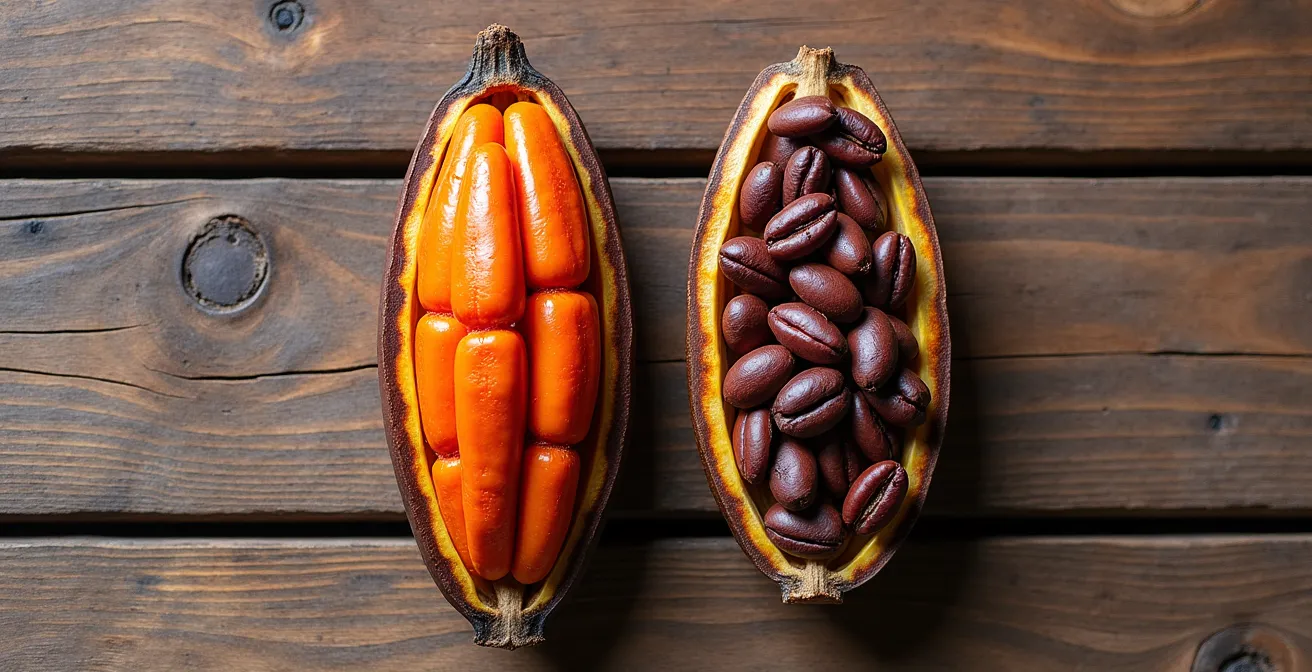
The true difference between single origin and blend chocolate isn’t just geography; it’s a story of distinct choices from the farm to the final bar.
- The unique flavor of an origin, like the fruitiness of Madagascan beans, is born from a specific microbial signature during fermentation.
- Post-harvest processing, especially drying and roasting methods, either carefully preserves these delicate origin notes or erases them in favor of a more generic “chocolatey” taste.
Recommendation: To truly understand the chocolate you love, learn to taste the story of its creation on your palate, not just read the origin on the wrapper.
You stand before a wall of beautifully packaged chocolate bars. The labels are a lexicon of exotic places: Ambanja, Madagascar; Soconusco, Mexico; Esmeraldas, Ecuador. You see terms like “single origin” and “blend,” but the distinction feels murky. The common wisdom says single origin comes from one place and is “better,” while blends are mixed for consistency. This explanation, however, barely scratches the surface and leaves you, the discerning chocolate lover, with more questions than answers.
What if the real story isn’t just about the *place*, but about the entire journey? As a Cacao Sommelier, I invite you to see beyond the label. Think of a chocolate bar not as a static product, but as the final chapter of a story written in the soil, shaped by the local air, and refined by the hands of farmers and makers. The true difference lies in a series of deliberate decisions—from the unique microbes in a fermentation pile to the precise temperature of a roast. A single origin bar aims to tell this specific, unedited story of its birthplace, while a blend acts as a curated anthology, weaving different narratives together for a desired, consistent experience.
This guide will not just define terms; it will empower you to decode that story. We will explore how the terroir imparts a unique personality to the bean, how processing choices can either amplify or mute its voice, and how you can train your own palate to hear these subtle tales. Forget the confusion; it’s time to start tasting with intention.
To navigate this world of flavor, we will delve into the specific factors that create a chocolate’s identity, from its agricultural roots to the final tasting experience. The following sections break down this journey step by step.
Summary: Decoding the Language of Fine Chocolate
- Why Do Madagascan Beans Taste Fruitier Than Ghanaian Varieties?
- How to Identify Ethical Cocoa Sources Without Relying on Generic Labels?
- Sun-Dried vs. Artificial Drying: What Changes in the Final Chocolate Bar?
- The Storage Error That Destroys the Floral Notes of Fine Cocoa in 2 Weeks
- In What Order Should You Taste 5 Different Origins to Avoid Palate Fatigue?
- Why Does Light Roast Cocoa Retain More Acidity Than Dark Roast?
- When is the Best Time of Year to Visit Cacao Plantations?
- How to Train Your Palate to Detect Red Fruit Notes in 70% Chocolate?
Why Do Madagascan Beans Taste Fruitier Than Ghanaian Varieties?
The answer lies in a concept wine lovers know well: terroir. This French term encompasses the soil, climate, and local environment, but in cacao, it extends to something even more specific: the microbial signature. When cacao beans are fermented, a complex ecosystem of local yeasts and bacteria gets to work. In Madagascar, these unique microbes produce a high concentration of fruity esters, the same organic compounds that give raspberries and citrus their bright, zesty aromas. This is why chocolate from this region is famous for its vibrant red fruit notes. While Madagascar provides less than 0.2% of the world’s cacao production, its flavor profile is unmistakable.
In contrast, the microbial terroir of Ghana, a powerhouse of cacao production, favors a different kind of fermentation. The process there develops the deep, classic “chocolatey” notes—rich, earthy, and robust—that many people associate with cocoa. Neither profile is inherently “better”; they are simply different expressions of their origin. As the Madagascar Chocolate Company notes, during fermentation, “the beans turn from purple to brown… unique local yeasts and bacteria in Madagascar’s fermentation piles create specific fruity esters.” This biological fingerprint is the secret behind the distinct personality of a single origin bar.
Case Study: Recreating Terroir in the Lab
The power of microbial terroir was vividly demonstrated by scientists at the University of Nottingham. They analyzed the specific microbe communities present during Madagascan fermentation and then recreated that environment in a controlled lab setting. The result? They successfully produced chocolate with the hallmark flavors of fine Madagascan samples, including “notes of orange blossom, citrus, berry, tropical fruit and flowers.” This experiment proves that the signature fruitiness isn’t just a happy accident but a direct result of the region’s unique microbiology.
Understanding this concept is the first step to appreciating single origin chocolate. You are not just tasting a place; you are tasting a complex biological process unique to that specific corner of the world.
How to Identify Ethical Cocoa Sources Without Relying on Generic Labels?
A chocolate’s origin story is as much about people as it is about place. Generic labels like “fair trade” can be a starting point, but they often don’t tell the whole story. To truly identify ethical sources, a Cacao Sommelier looks for signs of a deeper, more transparent relationship between the maker and the farmer. This is often called direct trade, where chocolate makers build long-term partnerships with specific farms or cooperatives, paying premium prices that far exceed commodity or even fair-trade minimums. This model ensures that more value remains in the hands of the growers and their communities.
Look for chocolate makers who are radically transparent about their sourcing. Do they name the specific farm, cooperative, or even the lead farmer on their packaging or website? Do they publish the “farm-gate” price they paid for their beans? This level of detail signifies a genuine connection and accountability that goes beyond a simple certification logo. Another powerful indicator is chocolate that is not just grown but also made entirely in the cocoa-growing country. This practice of “value-added at origin” keeps more of the profits and skilled jobs within the local economy, transforming it from a raw material supplier into a producer of fine, finished goods.
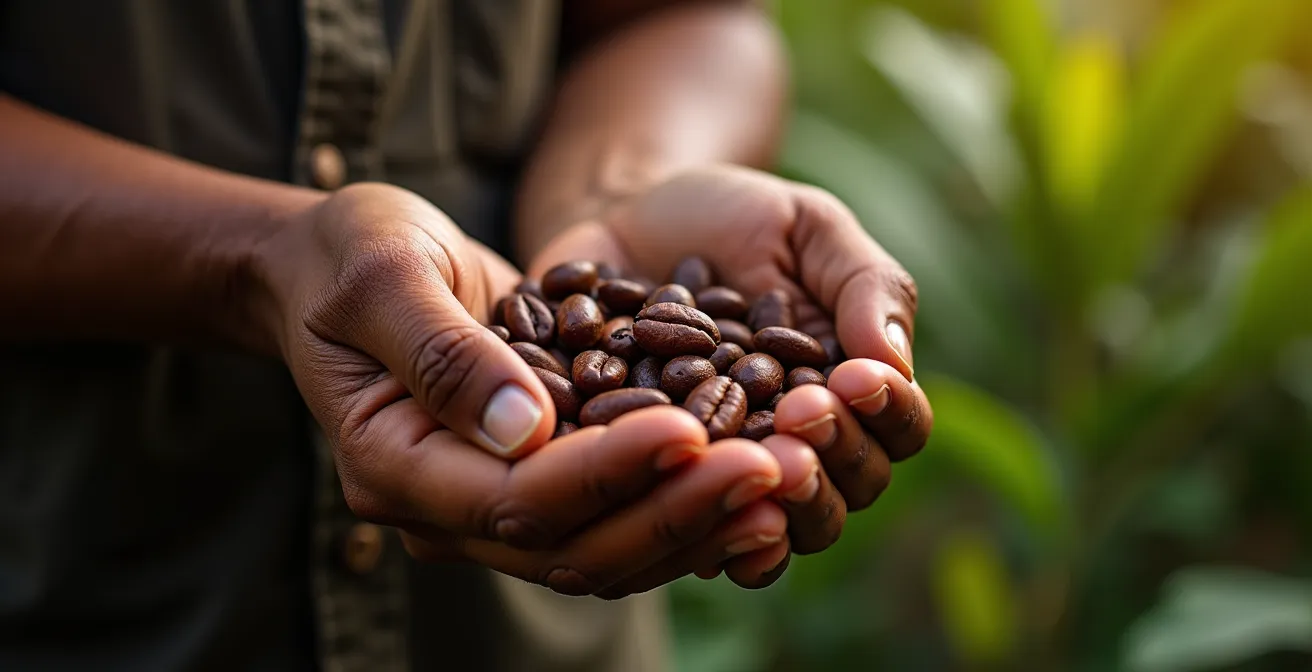
This image of hands exchanging beans symbolizes the core of ethical sourcing: a direct, human connection that honors the skill and labor of the farmer. It represents a partnership, not just a transaction. When you support makers who foster these relationships, you are investing in a more sustainable and equitable future for the entire cocoa industry, ensuring that the beautiful stories of origin can continue to be told.
Your Checklist for Ethical Chocolate Sourcing
- Farmer Identification: Look for specific farmer names and co-op details on the maker’s website to verify a direct link.
- Price Transparency: Check for published ‘farm-gate prices’ in sourcing reports, ensuring farmers are paid a premium.
- Origin-Made Priority: Prioritize chocolate made entirely in the cocoa-growing country, where value is added at the source.
- Traceability Verification: Verify if blockchain tracking or other direct trade documentation is available to follow the bean’s journey.
- Partnership Longevity: Research if the maker maintains and highlights long-term, multi-year partnerships with specific farms.
Sun-Dried vs. Artificial Drying: What Changes in the Final Chocolate Bar?
After fermentation, the wet cacao beans must be dried to a moisture level of around 7% before they can be stored and shipped. This seemingly simple step is another critical decision point that dramatically shapes the final flavor. There are two primary methods: traditional sun-drying and modern artificial drying. Sun-drying is a slow, gentle process that can take five to nine days. During this time, the beans are spread out on patios or wooden beds and turned regularly. This prolonged, low-temperature exposure allows for a final stage of gentle flavor development. Acetic acid, a byproduct of fermentation that can taste harsh, continues to evaporate, reducing astringency and allowing more delicate, complex aromatics to emerge.
As renowned farmer and chocolate maker Bertil Akesson explains, “slow sun-drying initiates gentle flavor development and reduces astringency in ways that rapid, high-heat artificial drying cannot replicate.” In contrast, artificial drying uses heated tunnels or rotary dryers to accomplish the task in just 24 to 48 hours. While this method offers precise temperature control and a lower risk of environmental contamination, it can “lock in” some of the acidity and result in a cleaner, but potentially flatter, flavor profile. The rapid heat doesn’t allow for the same nuanced chemical transformations that occur under the gentle warmth of the sun.
The choice of drying method is often dictated by climate. In rainy regions, sun-drying is impractical, making artificial dryers a necessity. However, for many fine-flavor origins, sun-drying is a deliberate choice to enhance complexity. The following table breaks down the key differences.
| Aspect | Sun-Drying | Artificial Drying |
|---|---|---|
| Duration | 5-9 days | 24-48 hours |
| Temperature Control | Natural variation | Precise control |
| Flavor Development | Complex, nuanced | Clean but potentially flat |
| Risk of Contamination | Higher (smoke, environment) | Lower (controlled environment) |
| UV Impact on Polyphenols | Creates delicate aromatics | No UV transformation |
The Storage Error That Destroys the Floral Notes of Fine Cocoa in 2 Weeks
You’ve invested in a beautiful bar of single-origin chocolate. The farmer, the fermenter, and the chocolate maker have all done their part. Now, the final, crucial stage of preservation is in your hands. Improper storage is the fastest way to erase the delicate, volatile compounds that make fine chocolate special. The most common mistake is not temperature itself, but humidity and exposure to strong odors. Chocolate is highly porous and will absorb any aromas around it, whether it’s the coffee in your pantry or the cheese in your refrigerator. Storing it in the fridge is a particularly damaging error.
The cold, humid environment of a refrigerator is disastrous for two reasons. First, it causes “sugar bloom,” where moisture dissolves sugar on the surface, leaving a gritty, white-streaked texture when it evaporates. Second, and more importantly for flavor, it dulls the very aromatic compounds you paid a premium for. Fine chocolate should ideally be stored in a cool, dark, and dry place, with an optimal temperature range of 65-70°F (18-21°C). It should be kept in its original packaging or an airtight container, far from any strong-smelling foods.
Case Study: The Science of Disappearing Aromas
Lake Champlain Chocolates conducted an experiment that clearly documented the impact of humidity on flavor. They found that storing chocolate at humidity levels above 55% not only causes sugar bloom but also permanently alters the way flavors are released on the palate. The most fragile and volatile aromatic compounds, such as the linalool responsible for delicate floral notes, were the very first to disappear. Within two weeks, a complex, floral bar could be reduced to a one-dimensional, muted version of its former self, proving that proper storage is not just about texture, but about preserving the very soul of the chocolate.
Think of your fine chocolate as a living product. Its aromatic bouquet is precious and fleeting. By protecting it from its enemies—humidity, heat, light, and strong odors—you ensure that every bite delivers the full, complex story that the maker intended for you to experience.
In What Order Should You Taste 5 Different Origins to Avoid Palate Fatigue?
To truly appreciate the nuances between different origins, a structured tasting is essential. Just as a wine sommelier wouldn’t start with a heavy Cabernet before a light Pinot Grigio, a Cacao Sommelier must curate the tasting order to prevent palate fatigue. The goal is to move from the most delicate and acidic profiles to the most robust and tannic. This allows your palate to perceive the subtle notes of each bar without being overwhelmed by the intensity of the previous one. A common mistake is to taste based on cocoa percentage alone, but intensity is a more important guide.
A professional tasting flight should be approached with a clear strategy. You’ll need palate cleansers on hand, such as room-temperature sparkling water and neutral-flavored crackers or a plain piece of bread. These help reset your taste buds between each sample. The sequence itself is paramount. By arranging the chocolates from high-acidity and low-tannin to low-acidity and high-tannin, you create a journey for your palate that builds in intensity in a logical, perceptible way.
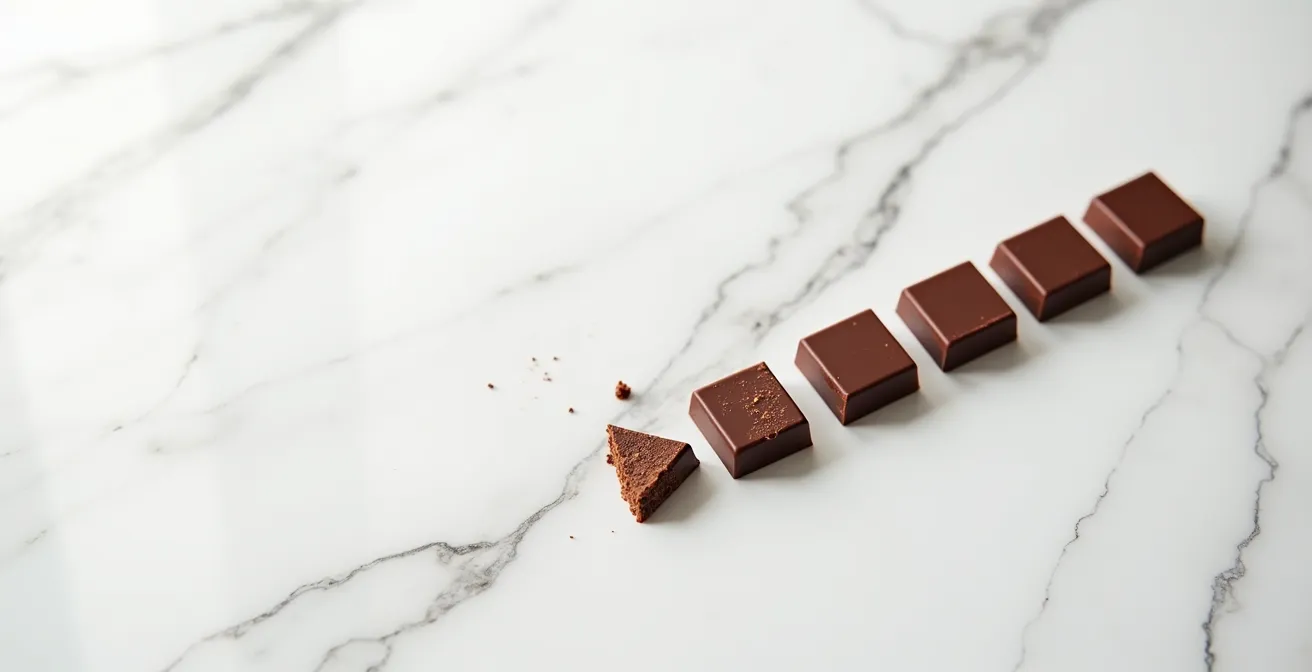
Here is a professional sequence for tasting five different origins to maximize your sensory experience:
- Start with high-acidity, low-tannin profiles. Chocolates from Madagascar are a classic starting point due to their bright, fruity, and acidic nature.
- Progress to medium-acidity, balanced profiles. Venezuelan origins often fit this category, presenting a harmonious balance of fruit, nut, and cocoa notes.
- Move to low-acidity, high-tannin varieties. Chocolates from Ecuador, known for their floral and earthy notes with a more powerful structure, are a good next step.
- Introduce intensely earthy or smoky profiles. Bars from places like Papua New Guinea, which can have unique smoky notes from their drying process, should come later.
- Finish with the most robust and bitter profiles. This could be a very dark roast or an origin known for its powerful, classic cocoa bitterness, such as certain Ghanaian beans.
Remember to prioritize the flavor intensity over the cocoa percentage. A mellow, fruity 70% bar should always be tasted before a punchy, intense 65% bar.
Why Does Light Roast Cocoa Retain More Acidity Than Dark Roast?
Roasting is one of the most transformative stages in chocolate making, where hundreds of flavor compounds are created. The chosen roasting profile—the combination of temperature and time—is a deliberate decision that defines the final character of the bar. A light roast is designed to preserve the bean’s inherent origin flavors, while a dark roast is intended to create new, roasty flavors. The key difference comes down to the chemistry of organic acids and the formation of compounds called pyrazines.
During fermentation, acids like acetic and citric acid develop in the cacao bean. These are the primary sources of the bright, fruity, and acidic notes characteristic of certain origins. As Eric, a master chocolate maker at Dandelion Chocolate, explains, “Light roasts don’t break down the volatile organic acids developed during fermentation, which are the primary sources of bright, fruity notes.” A gentle, light roast provides just enough heat to reduce unwanted raw flavors without destroying these delicate acids, thus preserving the bean’s terroir narrative. This is why a light-roasted Madagascan bar tastes intensely of red berries.
A dark roast, on the other hand, uses higher temperatures for a longer duration. This intense heat breaks down the original organic acids, effectively muting the fruitiness and acidity of the origin. In their place, the Maillard reaction and Strecker degradation create an abundance of pyrazines, the compounds responsible for the nutty, toasty, and classic “roasty” flavors we associate with coffee and dark chocolate. A dark roast creates a bold, comforting flavor profile but does so at the expense of the bean’s original, nuanced personality.
This comparative analysis of cocoa chemistry shows the trade-offs involved in the roasting process.
| Roast Level | Acid Preservation | Bitter Compounds | Flavor Profile |
|---|---|---|---|
| Light Roast | Preserves acetic & citric acids | Minimal pyrazine formation | Bright, fruity, acidic |
| Dark Roast | Acids break down | High pyrazine generation | Bitter, roasty, less acidic |
When is the Best Time of Year to Visit Cacao Plantations?
For the true chocolate aficionado, the ultimate experience is to connect with the source by visiting a cacao plantation. This journey to origin offers an unparalleled sensory immersion and a deep appreciation for the craft. However, timing is everything. To witness the most dynamic and aromatic stages of production, you should plan your visit to coincide with the post-harvest fermentation and drying periods. This is when the magic truly happens.
Most cacao-growing regions are located within 20 degrees of the equator. Many, like those in Colombia and Ecuador, have two harvest seasons per year, offering more flexibility for visitors. However, others, like Madagascar, have one main harvest. The key is to research the specific region you plan to visit. The goal is to be there when the air is thick with the sweet, vinegary aroma of fermenting cacao and farmers are actively turning the beans. This sensory-rich experience is unforgettable and provides profound insight into the birth of chocolate’s flavor.
Planning a Trip to Origin: The Madagascar Example
In Madagascar, the main cacao harvest typically begins around September. The most engaging time for a visitor to be on a farm is during the weeks immediately following the harvest, from late September through November. This is when you can witness the critical 6-day fermentation process firsthand, see the beans change color from vibrant purple to rich brown, and watch them being carefully spread out for sun-drying. It’s a multi-sensory experience that connects you directly to the terroir and the people behind the chocolate.
While the harvest is the most exciting time, visiting during the off-season can also be rewarding. It offers a quieter, more intimate opportunity to walk through the cacao groves and have in-depth conversations with farmers about cultivation practices without the pressure of harvest activities. Here are some key points for planning your trip:
- Target the fermentation period: This post-harvest window offers the richest sensory experience.
- Consider dual-harvest regions: Equatorial countries like Colombia and Ecuador provide two opportunities to visit during harvest each year.
- Plan for the off-season for deeper conversations: If your focus is on cultivation, a quieter time can be more insightful.
- Research specific harvest times: For Madagascar’s main harvest, aim for a trip between September and November.
- Allow enough time: Plan for at least 3-4 days on a farm to witness the full arc of the fermentation process.
Key Takeaways
- A chocolate’s flavor is not random; it is a direct result of terroir, microbial activity during fermentation, and post-harvest choices like drying and roasting.
- Ethical sourcing goes beyond generic labels, prioritizing direct trade relationships, price transparency, and value-added production at the origin.
- As a consumer, your role is crucial: proper storage protects the delicate aromatic compounds, and a structured tasting order unlocks the ability to appreciate them.
How to Train Your Palate to Detect Red Fruit Notes in 70% Chocolate?
Tasting is a skill, not just an act. The ability to detect specific flavor notes like “red fruit” in a 70% Madagascan bar can be cultivated through a practice known as palate calibration. This involves training your brain to recognize and name specific aromatic compounds by creating a sensory library of references. You can’t identify a flavor you don’t have a clear memory of. The process requires focus, patience, and a methodical approach that isolates different sensory inputs before combining them.
The first step is to experience the reference flavor in its pure form. Before tasting the chocolate, eat a fresh raspberry. Pay close attention to its aroma, its specific type of sweetness, and its bright acidity. This calibrates your palate. Next, you must learn to separate taste from aroma. Our perception of “flavor” is actually a combination of the five basic tastes detected by the tongue (sweet, sour, bitter, salty, umami) and the thousands of aromas detected by the nose. By temporarily blocking your sense of smell, you can isolate the foundational tastes of the chocolate before being flooded by its more complex aromatics.
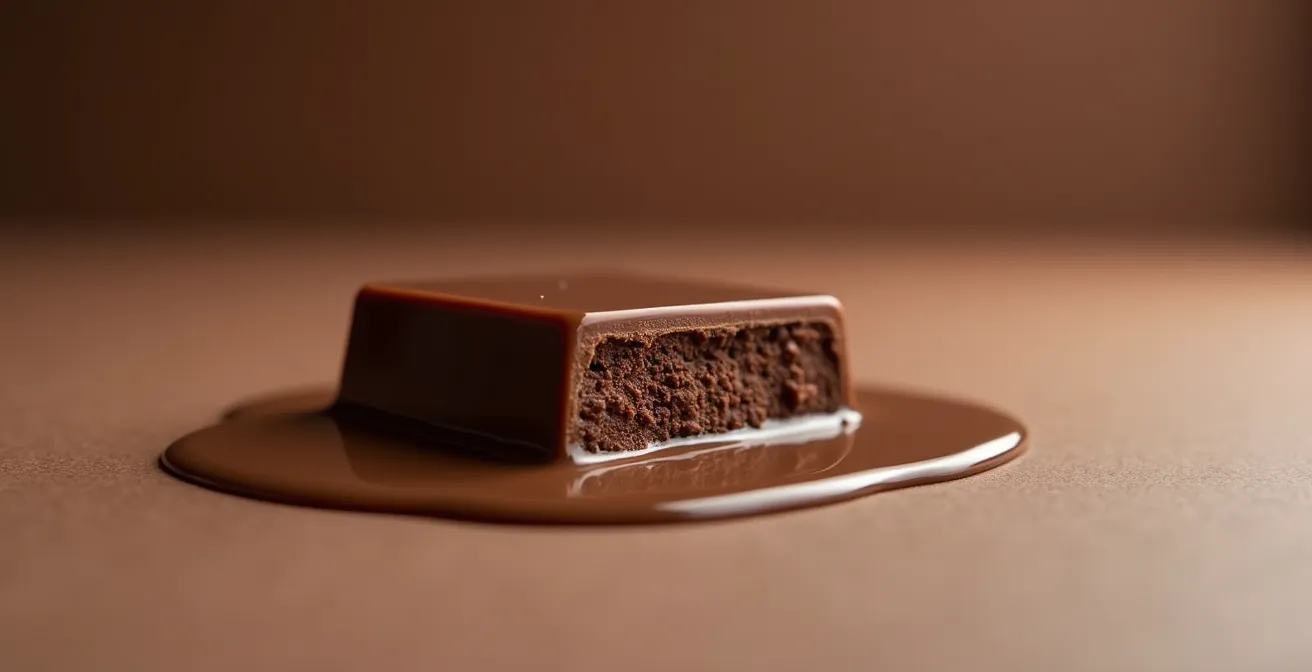
This close-up shows the most critical moment in tasting: the melt. As the chocolate transitions from solid to liquid on your tongue, its fats release the volatile aromatic compounds. This is the moment the “flavor” truly blooms. To train your palate to capture it, follow this professional method:
- Sensory Calibration: Taste a fresh raspberry immediately before the chocolate. Close your eyes and focus on its specific flavor profile.
- Isolate Basic Tastes: Place a small piece of chocolate in your mouth and, while pinching your nose, let it begin to melt. Notice only the basic tastes: is it primarily bitter, sweet, or acidic?
- Experience the Aromatic Wave: After about 15-20 seconds, release your nose. You should experience a rush of aroma. This is where the “flavor notes” like red fruit will emerge. Because you just tasted a raspberry, your brain is primed to find a similar note.
- Conduct a Side-by-Side Comparison: Taste the fruity Madagascan bar next to an earthy Ghanaian bar. The high contrast between the two will make the unique characteristics of each much easier to identify.
- Let it Linger: Allow the chocolate to melt completely and coat your tongue before swallowing. The finish, or aftertaste, often reveals another layer of subtle flavors.
By approaching your next chocolate bar not just as a confection but as a story waiting to be told, you unlock a new world of appreciation. Start your tasting journey today, and discover the incredible diversity of flavor that fine cacao has to offer.
Frequently Asked Questions About Single Origin vs. Blend: Which Bean Profile Fits Your Palate Best?
Why can’t I taste the fruit notes others describe?
Flavor perception develops with practice. Start with high-contrast comparisons between origins (e.g., a fruity Madagascan vs. an earthy Ghanaian bar) and use fresh fruit references, like eating a raspberry right before tasting, to calibrate your palate. Over time, your brain will build a sensory library, making these notes easier to identify.
Does chocolate temperature affect flavor detection?
Yes, absolutely. Chocolate releases different aromatics as it warms from a solid to a liquid in your mouth. The ideal temperature for tasting is room temperature (around 68-72°F or 20-22°C), as this allows the cocoa butter to melt smoothly and release the full spectrum of delicate fruit and floral notes. Cold chocolate will taste muted.
How long should I let chocolate melt before evaluating?
Patience is key. Allow the chocolate to sit on your tongue for at least 20-30 seconds. This initial melting phase reveals the primary tastes (bitter, sweet, acid). For the full experience, let it dissolve completely to release the entire aromatic profile, paying attention to how the flavors evolve and what notes linger in the finish.