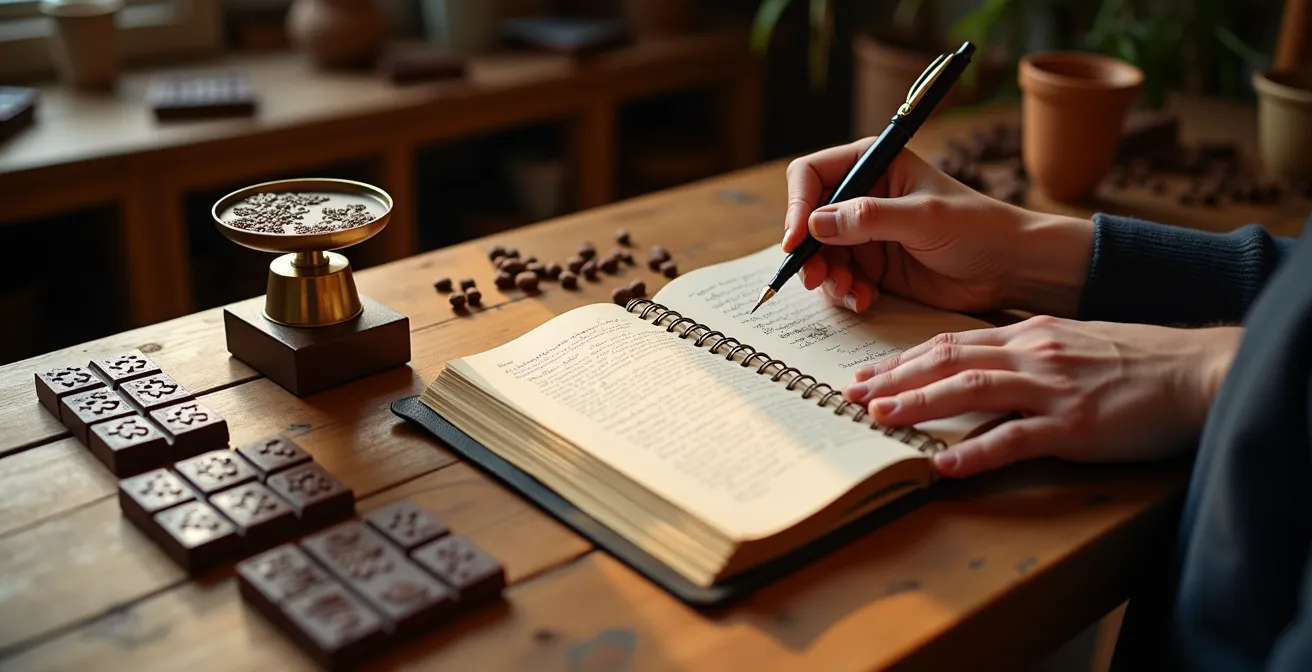
Boosting chocolate sales isn’t about listing more flavor notes; it’s about architecting a complete sensory experience for the customer.
- External cues like sound and scent measurably alter the perception of taste and value.
- Packaging choices (minimalist vs. illustrated) dictate the narrative and perceived luxury before the first bite.
Recommendation: Shift your focus from describing the product to directing the customer’s entire sensory journey.
You’ve done everything right. You’ve sourced incredible bean-to-bar chocolate, written down the origin, the cacao percentage, and the three primary tasting notes a sommelier would recognize. Yet, you watch as a customer scans the label, their eyes glazing over, before they simply ask, “Is it sweet?” This is the frustrating reality for many chocolatiers and food bloggers whose product descriptions are technically correct but emotionally sterile. They’re broadcasting facts, but they’re failing to create an experience.
The common advice is to use more sensory words or tell the bean’s story. While important, this approach often misses the most powerful tool in your arsenal: context. Your descriptions aren’t just a list of ingredients or notes; they are a script for the palate, a set of stage directions for a multi-sensory performance. The secret to selling more chocolate isn’t just about describing what’s inside the bar—it’s about designing the entire environment and anticipation around it.
What if the true key to unlocking a 20% sales increase wasn’t in adding another adjective, but in understanding how sound changes flavor? This is the core of sensory architecture: the art of using words to build a world around your product, influencing perception before the first bite is even taken. It’s about transforming a simple tasting into a memorable event.
This guide will deconstruct how to move beyond flat descriptions. We will explore how sound, sight, and even surprise can be woven into your narrative to create powerful emotional connections. We’ll show you how to host tastings that captivate non-experts and how to use packaging and tasting cards as critical chapters in your chocolate’s story, ultimately turning passive readers into eager customers.
To help you master this art, this article breaks down the essential strategies for crafting descriptions that do more than inform—they enchant. The following sections will guide you through the key elements of sensory storytelling.
Summary: A Guide to Sensory Chocolate Copywriting
- Why Does Eating Chocolate While Listening to Jazz Change the Flavor?
- How to Host a Chocolate Tasting Party That Engages Non-Experts?
- Minimalist Box vs. Illustrated Wrapper: Which Convey Luxury Better?
- The Scented Candle Mistake That Ruins Your Guest’s Palate Instantly
- When to Include a Tasting Card to Guide the Customer’s First Bite?
- Why Is ‘Gritty’ the Most Hated Texture in Chocolate?
- Why Does Hidden Popping Candy Create an Emotional Reaction?
- Where to Find the Best Bean-to-Bar Workshops in Your City?
Why Does Eating Chocolate While Listening to Jazz Change the Flavor?
The idea that sound can alter the taste of food isn’t a marketing gimmick; it’s a proven scientific phenomenon known as cross-modal correspondence. Our brains don’t experience senses in isolation. What we hear actively shapes what we taste. High-pitched, tinkling sounds can genuinely make chocolate taste sweeter, while low-frequency, dissonant tones can bring out its bitterness and complexity. This happens because our brain automatically forms associations between different sensory inputs. For instance, a study on the subject demonstrated that sour stimuli are accentuated by dissonant musical intervals, creating an unpleasant response, while staccato notes can make a flavor feel more energetic.
For a chocolate seller, this is a revolutionary concept. Your product description can become a sonic suggestion. By describing a chocolate with “notes as smooth and sustained as a cello’s hum,” you are not just painting a picture; you are priming the customer’s brain to perceive a smoother texture. This transforms your description from a passive label into an active tool for directing the tasting experience. You can even create brand-specific playlists to pair with your products, linking them with a QR code on the packaging to take full control of the sensory environment.
Here’s how to start pairing sound with different chocolate types:
- Creamy Milk Chocolate (30-40% cacao): Pair with consonant, long flute notes and music with large hall reverberation. This enhances the perception of smoothness and creaminess.
- Complex Dark Chocolate (70%+): Use loop-ascending scales with dissonant, dry pizzicato violin lines to accentuate its intricate, bitter notes.
- Sweet Chocolate Profiles: Match with higher-pitched sounds from instruments like trumpets or bells to amplify the perceived sweetness.
- High-Percentage Bitter Chocolate: Pair with low-pitched sounds from a cello or bass to enhance and deepen the complex bitterness.
By understanding this connection, your descriptions can guide customers to not just taste your chocolate, but to *listen* to it, creating a far richer and more memorable experience.
How to Host a Chocolate Tasting Party That Engages Non-Experts?
The biggest mistake in hosting a chocolate tasting for novices is treating it like a final exam. Asking “What notes do you taste?” puts guests on the spot and often leads to silence or generic answers like “chocolaty.” To truly engage people, you must shift the goal from technical analysis to emotional connection and sensory exploration. The objective isn’t to identify the “correct” flavor notes but to create a space for personal discovery and storytelling. This approach works; sensory storytelling and interactive content can boost engagement by up to 50% because it makes the experience personal and memorable.
Instead of a formal tasting, frame the event as a “Flavor-Memory Game.” The focus should be on encouraging guests to explore textures and link flavors to their own experiences. This makes the tasting accessible and fun, regardless of a person’s palate or expertise. Start with blind tastings that focus on texture first—the silky feel of a perfectly tempered bar, the rustic crunch of stone-ground chocolate, the surprising pop of hidden candy. This grounds the experience in a physical sensation that everyone can identify.
This image of hands exploring different textures perfectly captures the spirit of a successful tasting: it’s about tactile discovery, not just taste.
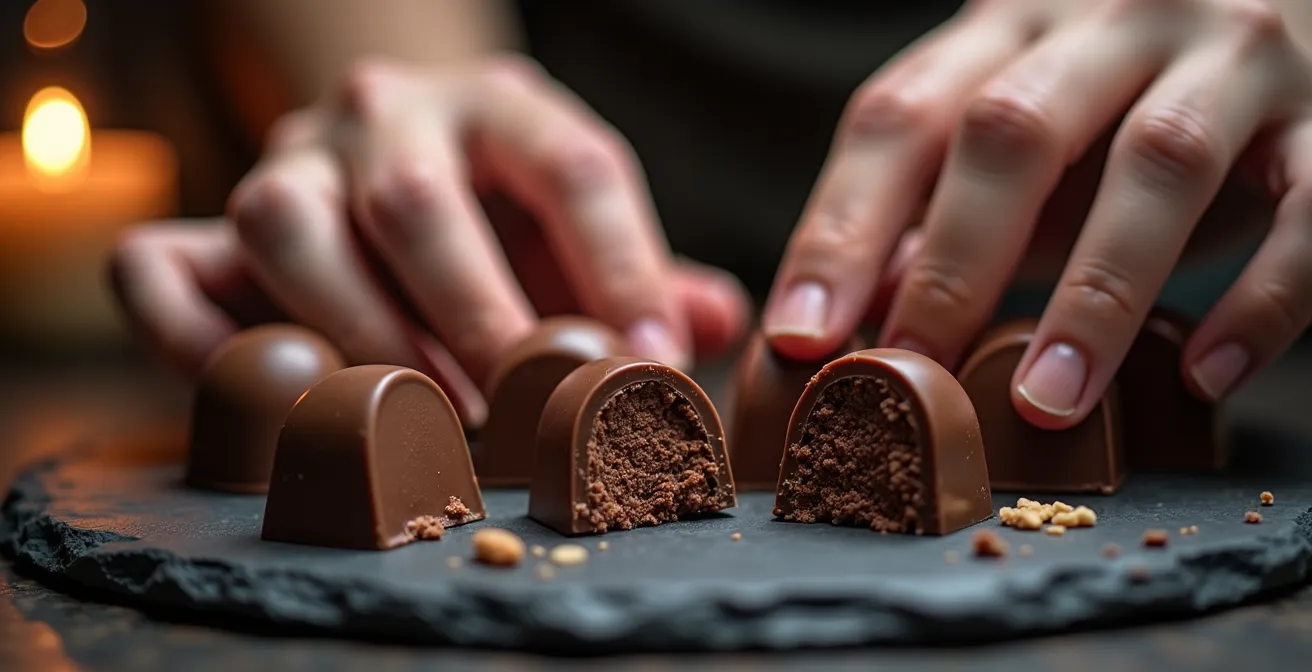
As you can see, the focus is on interaction and curiosity. To facilitate this, use questions that spark imagination rather than test knowledge. Here’s a framework:
- Instead of asking “What notes do you taste?”, ask “What specific memory does this flavor evoke?” This invites personal stories, not technical jargon.
- Create narrative themes for your tasting flights, like “The Explorer’s Journey” for single-origin bars or “The Alchemist’s Lab” for infused chocolates.
- Use a simplified, analogy-based flavor wheel. Replace intimidating terms like “earthy” with more relatable descriptions like “smells like a forest after rain.”
- Use your own personal storytelling to introduce each chocolate, building an emotional bridge to its origin or the craft behind it.
By focusing on memory, story, and tactile sensation, you transform a potentially intimidating event into a delightful and shared experience that everyone will remember long after the last piece of chocolate has been enjoyed.
Minimalist Box vs. Illustrated Wrapper: Which Convey Luxury Better?
The debate between minimalism and intricate illustration in luxury packaging is not about which is “better,” but about which story you want to tell. Both can convey luxury, but they do so in fundamentally different ways, appealing to different consumer psychologies. The choice you make sets the stage for the entire product experience. A minimalist box whispers confidence, suggesting the chocolate inside is so exceptional it needs no embellishment. An illustrated wrapper, on the other hand, externalizes the narrative, making the art and craftsmanship of the packaging part of the luxury itself. This concept is known as narrative density—how much of the story is told before the product is even revealed.
A minimalist design creates intrigue and delays the narrative reveal, building anticipation for the unboxing ritual. It signals that the luxury is intrinsic to the product. This appeals to a consumer who values understated elegance and has confidence in their own taste. In this case, the product description on your website or menu becomes absolutely critical, as it must carry the full weight of the story that the packaging deliberately holds back.
An illustrated wrapper offers immediate visual gratification. It showcases bespoke craftsmanship through art, appealing to enthusiasts of artisan craft who value the story and the maker’s touch. The description then becomes complementary, enhancing the visual narrative already established by the wrapper. To help decide which path aligns with your brand, consider this breakdown from an analysis of go-to-market strategies for chocolate:
| Aspect | Minimalist Box | Illustrated Wrapper |
|---|---|---|
| Narrative Density | Creates intrigue, luxury is intrinsic | Externalizes story, narrative is the luxury |
| Perceived Effort | Signals confidence in product quality | Shows bespoke craftsmanship through art |
| Unboxing Ritual | Delays narrative reveal, builds anticipation | Immediate visual gratification |
| Target Consumer | Appeals to minimalist luxury seekers | Attracts artisan craft enthusiasts |
| Description Role | Critical – must carry full story | Complementary – enhances visual narrative |
Ultimately, the most luxurious choice is the one that is most authentic to your brand and most effective at priming the customer for the unique experience your chocolate offers.
The Scented Candle Mistake That Ruins Your Guest’s Palate Instantly
You’ve meticulously planned a chocolate tasting. The lighting is perfect, the music is subtle, and an elegant scented candle flickers in the corner, creating a cozy ambiance. Unfortunately, you’ve just sabotaged the entire experience. While creating a mood is important for making guests feel relaxed and appreciative, introducing a competing aroma is the fastest way to ruin a palate. Our sense of smell is directly linked to taste, and a phenomenon called olfactory fatigue can occur within just 15-20 minutes of exposure to a constant scent. Your nose simply stops registering the smell, but more importantly, it becomes less sensitive to the delicate, nuanced aromas of the chocolate you’re about to serve.
Think of a scented candle as a loud, obnoxious guest at a poetry reading. It doesn’t matter how beautiful the words are; no one can hear them over the noise. The vanilla, lavender, or sandalwood from a candle will bully the subtle notes of cherry, tobacco, or earth in a fine single-origin chocolate. Even scents that seem benign can cause interference. Perfumed soap in the bathroom can transfer to guests’ hands, creating a fragrant cloud every time they lift a piece of chocolate to their mouth, corrupting the nose-to-palate connection that is crucial for a true tasting.
To protect the integrity of your tasting, you must become a ruthless curator of your sensory environment. This means eliminating all competing scents to create a neutral “olfactory canvas.” The goal is for the only aroma in the room to be the chocolate itself.
Action Plan: Safeguard Your Tasting Environment
- Identify the most damaging odors: Fried food or garlic odors are the worst offenders, as they can linger for hours and completely overpower delicate chocolate notes. Ensure your tasting space is far from the kitchen.
- Audit the high-impact zones: Check the bathroom for perfumed soap. This scent transfers directly to hands and interferes with the crucial nose-to-palate connection. Replace it with an unscented version.
- Assess moderate-impact elements: Scented candles and diffusers cause olfactory fatigue within 15-20 minutes. Remove them from the tasting room entirely.
- Manage low-impact scents: Even fresh flowers can interfere. While their natural scents dissipate quickly, they should be removed at least 30 minutes before the tasting begins.
- Actively cleanse the space: To neutralize any lingering odors, place small, discreet bowls of unscented coffee beans or baking soda around the room. These act as natural odor absorbers.
By creating a scent-neutral environment, you ensure that the complex and beautiful aroma of the chocolate is the undisputed star of the show, allowing your guests to experience it in its purest form.
When to Include a Tasting Card to Guide the Customer’s First Bite?
A tasting card is more than a piece of paper; it’s an act of palate priming. It’s your opportunity to frame the customer’s experience, manage their expectations, and guide their attention before they even take their first bite. The decision to include one, however, is a strategic balance between education and letting the product speak for itself. A card is not always necessary, and in some cases, it can even detract from the experience. The key is to use a tasting card when the chocolate’s complexity might otherwise be missed or its unique characteristics could be misunderstood by the average consumer.
For a straightforward, familiar product like a classic 40% milk chocolate, a tasting card is often optional. The experience is intuitive, and the simple pleasure of its creamy, sweet profile needs little explanation. In this case, letting the chocolate’s quality speak for itself can be a powerful statement of confidence. However, for a product with high complexity and low accessibility—like a single-origin 85% bar from a rare terroir or an experimental bar with unusual infusions—a tasting card becomes essential. It acts as a translator, helping the customer navigate unfamiliar flavors and textures they might otherwise dismiss as “weird” or “off.”
An elegant tasting card, like those shown below, can transform a simple purchase into a curated journey, elevating the perceived value and creating a deeper connection with your brand.
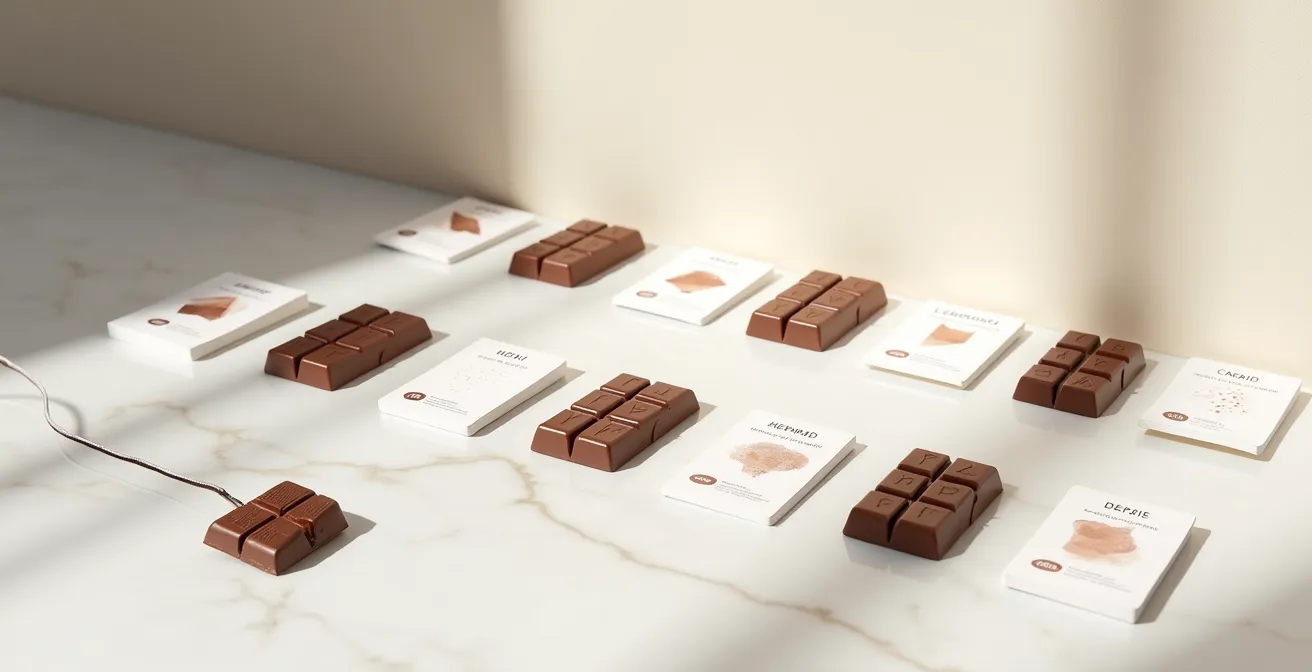
As the image suggests, the card becomes part of the aesthetic, an invitation to a more thoughtful experience. To decide when this invitation is necessary, use the following matrix, which balances product complexity against consumer accessibility.
| Product Type | Complexity Level | Accessibility | Card Recommendation |
|---|---|---|---|
| Single-Origin 85% | High | Low | Essential – educate on origin and notes |
| Milk Chocolate 40% | Low | High | Optional – let simplicity speak |
| Infused/Experimental | High | Medium | Recommended – manage expectations |
| Classic Dark 70% | Medium | High | Optional – familiar to most consumers |
| Raw/Stone-Ground | High | Low | Essential – explain texture and process |
By using tasting cards judiciously, you can educate your customers, manage their expectations, and transform a potentially challenging flavor profile into an exciting and appreciated discovery.
Why Is ‘Gritty’ the Most Hated Texture in Chocolate?
The word “gritty” is often a death sentence for a chocolate description. This visceral dislike doesn’t stem from the texture itself, but from a violation of expectation. For over a century, the industrial chocolate revolution, pioneered by figures like Rodolphe Lindt and his conching machine, has trained the global palate to equate “quality” with “silky smooth.” This mass-market conditioning has created a powerful, subconscious bias: smoothness is luxurious, while any other texture is a flaw. When a customer bites into a chocolate expecting silk and gets sand, the resulting cognitive dissonance is perceived as a defect, even if the texture is intentional.
However, for artisanal, bean-to-bar, and stone-ground chocolate makers, this “grittiness” is not a flaw; it is a feature. It is the authentic, rustic texture that results from a more traditional, less processed method. It speaks to the character of the cacao and the hand of the maker. The challenge for a copywriter isn’t to apologize for this texture, but to reframe it. You must intercept the customer’s pre-programmed expectation and give them a new lens through which to appreciate the experience. This is an act of texture reframing.
Instead of hiding from the texture, your description should celebrate it. By setting the expectation before the first bite, you transform a potential “flaw” into a mark of authenticity. The goal is to replace the negative association of “gritty” with positive, evocative language that signals craft and character.
Here are some ways to reframe texture in your descriptions:
- Replace “gritty” with positive descriptors like “rustic,” “authentic texture,” or “stone-ground character.”
- Use “character” or “textural complexity” instead of “rough” for stone-ground chocolate.
- Frame crystalline textures as an “artisanal formation,” similar to the prized crystals in an aged cheese or fine wine.
- Set expectations explicitly with phrases like, “Experience the traditional stone-ground texture that honors cacao’s true form.”
- Compare the texture to a familiar, positive sensory experience, such as “a pleasing crumble reminiscent of raw sugar crystals on a crème brûlée.”
By taking control of the narrative, you can guide your customers to appreciate the unique, tactile journey your chocolate offers, turning a moment of potential disappointment into one of delightful discovery.
Why Does Hidden Popping Candy Create an Emotional Reaction?
The sudden, unexpected crackle of popping candy in a smooth bar of chocolate triggers an immediate and powerful emotional reaction. This isn’t just about a fun sensation; it’s about the psychology of surprise. Our brains are wired to recognize patterns. When that pattern is broken—when the predictable experience of eating chocolate is interrupted by an unforeseen fizz and pop—it jolts us out of passive consumption and into a state of heightened awareness and delight. This sensory surprise can evoke a potent sense of childlike wonder and nostalgia, creating a far more memorable experience than flavor alone ever could.
This principle—that an unexpected emotional journey can be more powerful than a direct product message—is a cornerstone of brilliant marketing. A perfect example is the legendary Cadbury “Gorilla” ad campaign. The ad featured a gorilla passionately playing the drums to a Phil Collins song and had nothing to do with chocolate. Yet, it was a phenomenal success.
Case Study: The Cadbury Gorilla Campaign
The ad created a moment of pure, unadulterated joy and surprise. As one analysis from Wizard of Ads explains, the anticipation and elation viewers felt watching the gorilla created a powerful emotional transfer. Consumers felt, “If Cadbury’s is promoting this feeling, I hope I get that same feeling when I bite the chocolate bar.” This campaign, which focused entirely on creating an emotional reaction, led to record sales for two years straight, proving that emotion often sells better than information.
Popping candy is your “Gorilla moment” in a bar. The copywriter’s job is not to spoil the surprise by literally stating “contains popping candy.” Instead, your role is to build mystery and anticipation, hinting at a secret waiting to be discovered. This turns the description into part of the magic trick.
Here’s how to describe the indescribable without giving away the secret:
- Use evocative metaphors: “a quiet crackle,” “a secret celebration on your tongue,” or “a tiny, fizzing surprise.”
- Create anticipation without revealing the mechanism: “An unexpected journey begins with the third bite.”
- Focus on the emotional response, not the ingredient: “A bar designed to rediscover your sense of wonder.”
- Build a sense of mystery: “Listen closely. Something magical happens as it melts.”
By focusing on the emotional payoff of the surprise, you create a narrative that is far more compelling than a simple list of ingredients, leaving a lasting impression of joy and wonder.
Key Takeaways
- Taste is a multisensory experience; what customers hear, see, and smell directly impacts flavor perception and perceived value.
- Your product’s story is an integral part of the product itself. Packaging, tasting cards, and descriptions build a narrative that begins long before the first bite.
- Turn perceived flaws into celebrated features. By reframing textures and flavors, you can educate your customer’s palate and highlight your product’s unique character.
Where to Find the Best Bean-to-Bar Workshops in Your City?
You’ve learned the principles of sensory architecture and narrative description. Now, the final step to becoming a true authority is to immerse yourself in the craft firsthand. Moving from theory to practice by participating in a high-quality bean-to-bar workshop is the single best way to deepen your understanding and enrich your storytelling. An authentic workshop will take you through the entire magical process—from roasting and winnowing the beans to conching and tempering the chocolate. This hands-on experience will arm you with a wealth of sensory details, stories, and a genuine passion that will shine through in every product description you write.
However, not all workshops are created equal. Many are simply “melting and molding” classes disguised as a bean-to-bar experience. To find a legitimate workshop that offers real educational value, you need to know what to look for. A quality workshop is led by an actual chocolatier, focuses on small group sizes for hands-on learning, and covers the full process, including the crucial—and often overlooked—ethics of cacao sourcing. Searching with insider keywords like “cacao masterclass” or “chocolate tempering course” can help you bypass tourist traps and find professional-grade instruction.
To ensure you’re investing your time and money wisely, use the following checklist to assess any potential workshop.
Checklist: How to Vet a Quality Chocolate Workshop
- Sourcing and Story: Does the workshop cover sourcing ethics and the origin stories of the beans? A great workshop connects the final product back to the farm.
- Instructor Credentials: Verify that the instructor is a professional chocolatier with demonstrable experience, not just a hobbyist.
- Process Integrity: Confirm that the full bean-to-bar process is included. You should be working with cacao beans, not just melting pre-made chocolate.
- Group Size: Look for small group sizes, ideally with a maximum of 8-12 participants, to ensure you get personalized attention and hands-on practice.
- Search Strategy: Use specific keywords like “cacao masterclass,” “chocolate tempering course,” or “sensory analysis chocolate” to find professional-level training. Also, check adjacent industries like local coffee roasters or culinary schools, which sometimes offer high-quality chocolate courses.
By experiencing the bean-to-bar journey yourself, you will not only gain invaluable skills but also a deeper, more authentic voice that can transform your descriptions and captivate your audience.