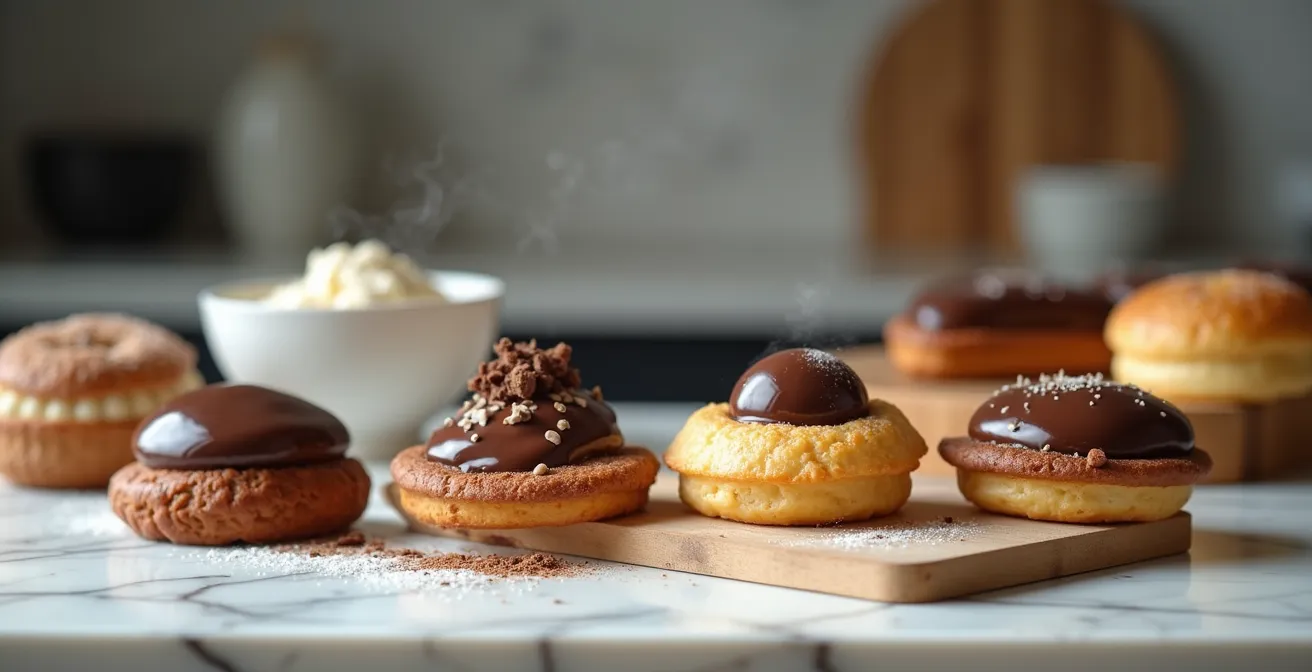
Successfully reducing sugar in chocolate pastry requires re-engineering the recipe’s entire structural matrix, not just swapping ingredients.
- Sugar provides more than sweetness; it’s a crucial bulking agent that manages moisture and creates tenderness.
- Alternative flours like oat flour, specific fats, and hydrocolloids (like aquafaba) can rebuild the texture that is lost when sugar is removed.
Recommendation: Stop focusing on sweetness replacement and start analyzing how to replace sugar’s functional properties to achieve a texturally perfect and satisfying result.
For the health-conscious baker, the mission to reduce sugar in chocolate pastry often ends in disappointment. The resulting cakes are dry, the brownies lack that signature fudgy chew, and the mousse feels… empty. This is a universal frustration, leading many to believe that pleasure and health are mutually exclusive in the world of patisserie. The common advice—use fruit purees or simply cut the sugar quantity—is a superficial fix that ignores the fundamental science of baking. These methods often compromise the very texture that makes a dessert decadent.
But what if the problem isn’t the reduction of sugar itself, but our approach to it? The key is to stop thinking like a home cook and start thinking like a reformulation scientist. The secret doesn’t lie in finding a single magic substitute for sweetness. It lies in understanding sugar’s multiple functional roles within the pastry’s structural matrix and systematically rebuilding that matrix with other ingredients. Sugar is a bulking agent, a moisture manager, a tenderizer, and a key player in the browning reactions that create deep flavor. Removing it leaves a significant void.
This guide will deconstruct the science of low-sugar chocolate pastry. We will explore how to analyze and replace sugar’s core functions, not just its taste. We will delve into the physics of flour particle size, the chemistry of moisture retention, and the biology of sensory perception. By the end, you will be equipped with the principles to re-engineer your favorite chocolate recipes, creating desserts that are both lower in sugar and uncompromisingly delicious, proving that textural perfection is achievable.
This article provides a structured approach to mastering low-sugar baking, breaking down the science into actionable steps. Explore the table of contents below to navigate the key principles of pastry reformulation.
Summary: How to Reduce Sugar in Chocolate Pastry Without Losing Texture?
- Why Do Low-Fat Chocolate Desserts Often Leave You Unsatisfied?
- Why Does Brown Sugar Make Cakes Fudgier Than White Sugar?
- The Flour Blend Mistake That Makes Your Chocolate Cake Gritty
- How to Replace Eggs in Brownies Using Aquafaba for Identical Results?
- How to Fortify Vegan Chocolate Mousse with Protein Without Altering Taste?
- How to Mix Milk and Dark Chocolate to Transition Gradually?
- How Small Can a ‘Bite-Sized’ Treat Be Before It Feels Stingy?
- Rustic Presentation vs. Geometrical Glaze: What Is Trending in Paris Now?
Why Do Low-Fat Chocolate Desserts Often Leave You Unsatisfied?
The dissatisfaction from low-sugar or low-fat chocolate desserts stems from a fundamental misunderstanding of sugar’s role. It’s not just a sweetener; it’s the primary bulking agent and moisture regulator in a recipe’s structural matrix. When you remove sugar, you create a void that disrupts mouthfeel, density, and tenderness. Fat, similarly, contributes to a smooth, lubricated mouthfeel and carries flavor. Reducing both simultaneously causes a complete collapse of the sensory experience. The resulting product is often perceived as dry, empty, and unsatisfying because the texture, which is just as important as flavor, has been destroyed. This also impacts browning, as less sugar means slower Maillard reactions and caramelization, potentially affecting baking time and final flavor profile.
As Gregory Ziegler, a Distinguished Professor of Food Science at Penn State, explains, this is a core challenge in food reformulation:
The function of sugar in chocolate is both sweetness and bulking, so if we take that sugar out, we have to put something else in that will do the job just as well, or consumers will notice.
– Gregory Ziegler, Distinguished Professor of Food Science at Penn State
The solution is not to simply reduce, but to replace these functional properties. For instance, recent research from Penn State University found that a 25% sugar reduction in chocolate maintained consumer acceptability when oat flour was used as a replacement bulking agent. This demonstrates that by identifying the function (bulk) and finding an appropriate substitute (oat flour), we can successfully re-engineer the recipe without a significant loss in sensory quality. The goal is to build a new, stable structure that delivers a satisfying experience, even with less sugar and fat.
Why Does Brown Sugar Make Cakes Fudgier Than White Sugar?
The secret to a fudgy, moist crumb in a reduced-sugar context lies in understanding the chemical differences between sugars. Brown sugar makes cakes fudgier than white sugar due to the presence of molasses. Molasses contains invert sugars (glucose and fructose) and is naturally hygroscopic, meaning it actively attracts and holds onto water molecules from the environment. This property is a powerful tool for a reformulation scientist. While white sugar (pure sucrose) also contributes to moisture, the molasses in brown sugar acts like a super-moisturizer, keeping the cake tender and preventing it from drying out, even with a lower overall sugar content.
When you reduce sugar, you’re also reducing a key tenderizing agent. Sugar interferes with gluten development and protein coagulation, which results in a softer texture. By using brown sugar, you are leveraging the hygroscopic power of molasses to compensate for some of that lost moisture-locking capability. This results in a denser, chewier, and more “fudgy” texture compared to the finer, more delicate crumb produced by white sugar. It’s a strategic way to enhance moisture without simply adding more liquid, which could disrupt the recipe’s balance.
This principle is so reliable that it allows for a baseline reduction in many recipes. For instance, King Arthur Baking’s extensive testing confirms that a 10% sugar reduction is possible in virtually any cake recipe without a noticeable compromise in texture or flavor, especially when the right type of sugar is used. For a baker looking to reduce sugar, switching from white to brown sugar is often the first and most effective step in re-engineering the recipe’s moisture matrix.
The Flour Blend Mistake That Makes Your Chocolate Cake Gritty
A common pitfall in low-sugar baking is creating a gritty, sandy texture. This mistake often originates not from the sugar substitute, but from the flour blend. When sugar, a key bulking and tenderizing agent, is reduced, the flour’s properties become more prominent and can negatively impact the mouthfeel. The grittiness is a direct result of the particle size of the flours or other dry ingredients used to replace sugar’s bulk. The human tongue is incredibly sensitive to texture, and the threshold for detecting particles is minuscule. In fact, scientific research on chocolate texture reveals that the Just Noticeable Difference for particle size is around 5 micrometers. If your bulking agent has a particle size larger than this, it will be perceived as gritty.
Many gluten-free flours or high-fiber flours used in “healthy” baking, such as certain rice flours or nut meals, have a larger and less uniform particle size than traditional wheat flour. This is where a reformulation scientist focuses: choosing a replacement that mimics sugar’s fine crystalline structure. Oat flour, for example, is an excellent choice because it can be milled to a very fine particle size and contains soluble fibers (beta-glucans) that form a gel, contributing to a smoother, creamier mouthfeel and compensating for the lost bulk of sugar.
The impact of different flours on both texture and consumer acceptance in sugar-reduced cakes is significant, as a comparative analysis shows.
| Flour Type | Sugar Reduction Capability | Texture Result | Consumer Acceptance |
|---|---|---|---|
| Oat Flour | Up to 25% | Smoother, creamier | Equal to control |
| Rice Flour | Up to 25% | Chalkier texture | Significantly lower |
| Regular AP Flour | 10-15% | Can become tough | Moderate decline |
| Cake Flour | 15-20% | Maintains tenderness | Good acceptance |
This data clearly indicates that simply substituting flour is not enough. To avoid a gritty texture, you must select a flour with a fine particle size and favorable textural properties, like oat or fine cake flour, to successfully rebuild the pastry’s structural matrix.
How to Replace Eggs in Brownies Using Aquafaba for Identical Results?
Replacing eggs in brownies while maintaining a dense, fudgy texture and a crackly top is a classic reformulation challenge. The solution lies in aquafaba, the viscous liquid from canned chickpeas. Aquafaba is a game-changer because its unique blend of proteins and starches allows it to mimic the functional properties of eggs: binding, leavening, and emulsifying. When whipped, it creates a stable foam very similar to egg whites, providing the structure needed for leavening and that coveted shiny crust. For binding, it works just as effectively in its liquid state.
However, achieving identical results requires more than a simple one-to-one swap. It demands a scientific approach to rebalance the entire formula. Since aquafaba has a high water content, adjustments to the recipe’s liquid and fat ratios are crucial to prevent a greasy or separated batter. Successfully using aquafaba is about understanding how it interacts with other ingredients in the structural matrix. The foam structure provides lift, but its stability must be managed.
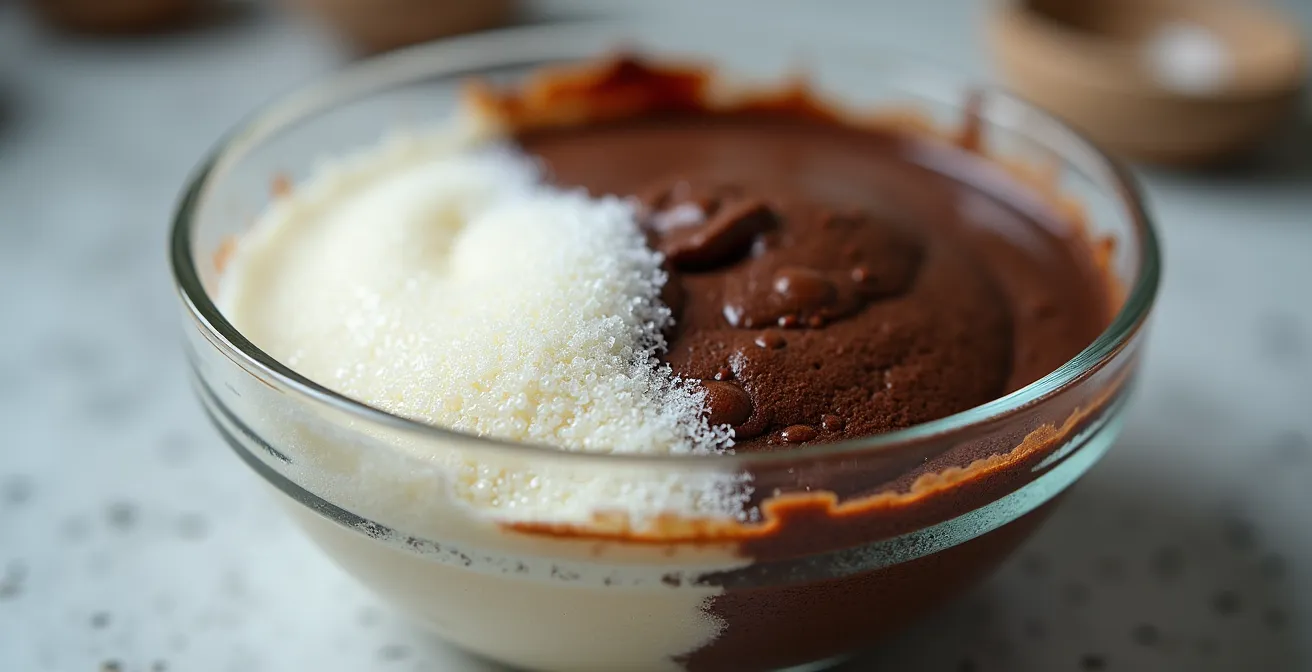
The image above illustrates the transition from the airy, delicate foam of whipped aquafaba to the rich, glossy brownie batter. This visual contrast highlights how a seemingly light ingredient can be the backbone of a dense, fudgy dessert. To replicate this consistently, following a precise protocol is essential.
Your Action Plan for Perfect Aquafaba Brownies
- Measure Precisely: Use exactly 3 tablespoons of aquafaba to replace one whole egg for optimal binding and moisture.
- Adjust Fats and Liquids: Reduce the oil or melted butter in your recipe by up to 50% and replace that volume with additional liquid aquafaba to ensure proper emulsification and prevent greasiness.
- Ensure Foam Stability: Add 1/8 teaspoon of cream of tartar for every 2 tablespoons of aquafaba before whipping. This acidifies the proteins, helping them create a stronger, more stable foam structure.
- Create the Shiny Top: For a crackly, meringue-like crust, whip the aquafaba with powdered sugar for at least 3 minutes until it forms stiff, glossy peaks before folding it into the batter.
- Boost Density: For an extra dense, fudgy texture, combine the liquid aquafaba with 1 tablespoon of ground flax meal (a flax “egg”) to enhance its binding and moisture-retaining properties.
How to Fortify Vegan Chocolate Mousse with Protein Without Altering Taste?
Fortifying a vegan chocolate mousse with protein without compromising its delicate, airy texture and rich flavor is a high-level reformulation task. The primary challenge is that many protein powders (like pea or soy) have strong off-flavors and a gritty texture that can completely ruin the sensory experience. The secret is not to add protein as a separate ingredient, but to use a base that is naturally protein-rich and functionally suited for creating a foam: aquafaba. As we saw with brownies, aquafaba is a powerful egg replacer, and in mousse, its foaming properties are paramount.
When whipped, aquafaba’s proteins denature and form a stable network that traps air, creating a light, voluminous structure identical to that made with egg whites. This process builds a protein-fortified dessert from the ground up. The key to success is ensuring the chocolate flavor is dominant enough to completely mask any subtle, beany notes from the aquafaba. Using a high-quality dark chocolate with a high cacao percentage (70% or more) provides the intensity needed. Additionally, a stabilizing agent like cream of tartar is essential to strengthen the protein network and prevent the mousse from weeping or collapsing over time.
Case Study: The Invisible Protein Mousse
Professional bakers have perfected a protein-rich vegan chocolate mousse using aquafaba as the sole structural agent. By whipping the liquid from one can of chickpeas with 1/4 teaspoon of cream of tartar until stiff peaks form, they create a stable, protein-containing base. This foam is then gently folded into 200g of high-quality melted dark chocolate. The result is a mousse with a delicate, airy texture and a deep chocolate flavor, where the added plant-based protein from the aquafaba is completely imperceptible to the palate. The technique proves that fortification can be achieved through functional ingredients rather than additives.
This approach is part of a larger trend in food science, where structure itself is used to enhance sensory properties. For instance, innovative chocolate structuring research demonstrates that a 19% sugar reduction can be achieved without loss of sweetness by creating multiphase internal structures. By using an ingredient that both fortifies and builds the desired structure, we create a more elegant and effective solution.
How to Mix Milk and Dark Chocolate to Transition Gradually?
Transitioning from the high-sugar sweetness of milk chocolate to the complex, bitter notes of dark chocolate can be jarring for many palates. A gradual, systematic approach is key to retraining sensory expectations. This involves creating a series of blends with progressively higher percentages of dark chocolate, allowing the taster to acclimate to lower sugar levels and more intense cacao flavors over time. This isn’t just about mixing; it’s about a controlled descent in sweetness and a controlled ascent in complexity. Starting with a blend dominated by milk chocolate and slowly shifting the ratio gives the palate time to adapt and begin appreciating the nuanced flavors of dark chocolate.
Beyond simple mixing, a reformulation scientist can manipulate sweetness perception through other ingredients, particularly fats. Fat content and type can dramatically alter how sweetness is perceived. This is because fats influence the melting behavior of chocolate in the mouth, which in turn controls the rate of tastant release—how quickly the sugar and flavor compounds dissolve in saliva and reach the taste receptors.
Case Study: Enhancing Sweetness with Hazelnut Oil
Recent research into how fat affects sweetness perception provides a powerful insight. Scientists found that chocolate masses with a higher content of hazelnut oil, which has a lower melting point than cocoa butter, were perceived as 24% sweeter than control samples with the same sugar content. The faster-melting fat accelerated the release of sucrose into the saliva, leading to a more intense, immediate sweetness sensation. This demonstrates that by strategically modifying the fat composition, one can enhance perceived sweetness without actually adding more sugar, providing another tool for creating satisfying low-sugar chocolate.
For a practical approach at home, a structured transition schedule is the most effective method to adapt the palate to enjoy the robust character of dark chocolate.
Checklist for a Gradual Chocolate Transition
- Week 1 (Introduction): Start with a gentle blend of 80% milk chocolate and 20% dark chocolate (65-70% cacao). This introduces a hint of bitterness without being overwhelming.
- Week 2 (Adjustment): Move to a 70% milk and 30% dark chocolate mix. The cacao notes will become more noticeable.
- Week 3 (Balancing): Create a 60% milk and 40% dark chocolate blend. At this stage, the complexity of the dark chocolate begins to balance the creaminess of the milk.
- Week 4 (Midpoint): Use a 50/50 blend. This is a critical point where the palate starts to recognize and appreciate the distinct qualities of both chocolates.
- Week 5 (Advancement): Shift the balance further to 40% milk and 60% dark chocolate. The rich, deep flavors of dark chocolate are now the dominant profile.
Key Takeaways
- Reducing sugar is a structural engineering problem, not a substitution problem. Focus on replacing sugar’s functions: bulk, moisture, and texture.
- Ingredient choice is critical. Fine-particle flours like oat flour prevent grittiness, while hygroscopic sugars like brown sugar enhance moisture.
- Advanced techniques like using aquafaba for foam or manipulating fat composition to alter sweetness perception are key to creating satisfying “free-from” pastries.
How Small Can a ‘Bite-Sized’ Treat Be Before It Feels Stingy?
The question of portion size for “bite-sized” treats is less about physical dimension and more about sensory satisfaction. A treat can be very small yet feel generous if it delivers a complex, evolving sensory experience. Conversely, a larger treat with a monotonous texture and flavor can feel unsatisfying and “stingy” on pleasure. The key is to design the treat’s internal structure to maximize sensory impact. As a reformulation scientist, the goal is to create multiple layers of texture and flavor that unfold as the treat is consumed. This creates a longer-lasting and more memorable experience, making a small portion feel substantial.
This concept is supported by the principle of pulsatile stimulation. Instead of a homogeneous product where taste is delivered uniformly, a layered treat with varying textures (e.g., a crisp shell, a creamy ganache, a crunchy nut inclusion, a liquid caramel center) stimulates taste receptors discontinuously. This dynamic experience can enhance the overall perception of sweetness and satisfaction, allowing for a significant reduction in both sugar and portion size without the consumer feeling deprived. The complexity of the experience compensates for the lack of volume.
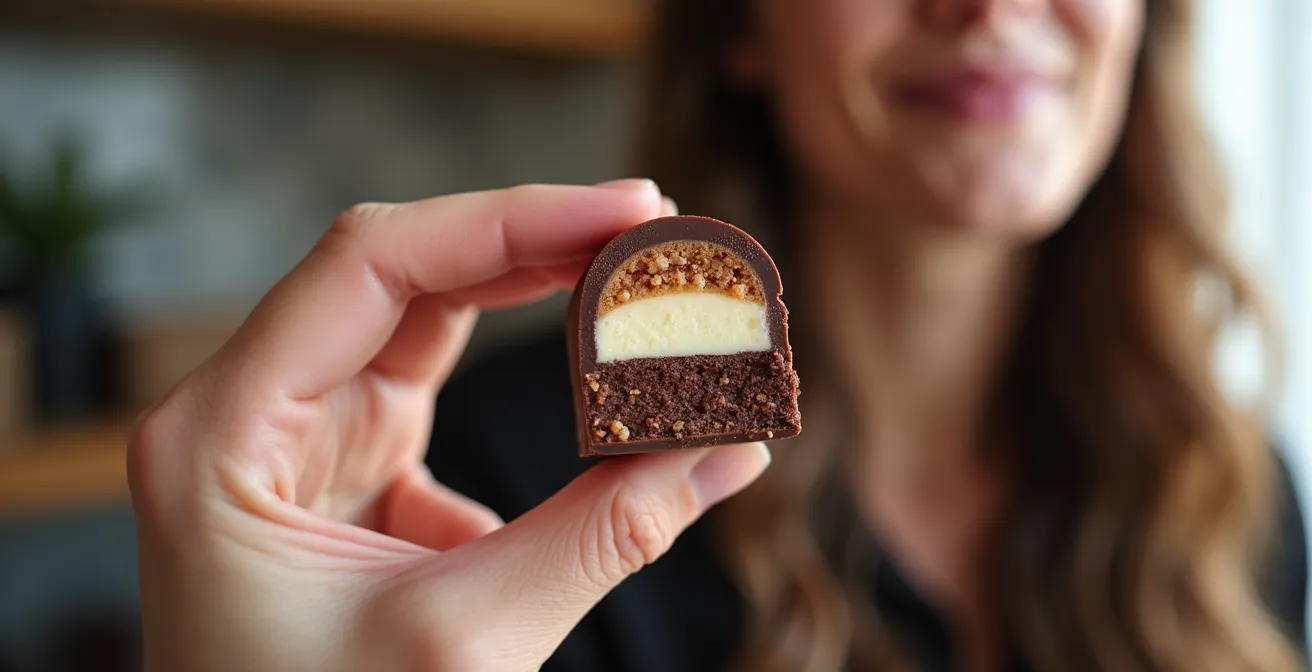
Consider the delicate, layered chocolate bonbon shown above. Its small size is irrelevant because its value lies in the intricate construction. Each layer—the thin, snapping shell, the melting ganache, the crunchy base—provides a distinct moment of pleasure. This multi-textural journey makes the single bite feel like a complete dessert experience. Therefore, the limit on how small a treat can be is defined not by inches or grams, but by its ability to deliver a rich, multi-sensory narrative in a single bite.
Rustic Presentation vs. Geometrical Glaze: What Is Trending in Paris Now?
The current trend in Parisian patisserie is a subtle but significant shift away from the flawless, mirror-like geometrical glazes that dominated the last decade. While technical perfection is still revered, there is a growing movement towards a more “rustic” aesthetic. However, this is not a return to careless, homespun desserts. Instead, this new rusticity is an intentional choice that prioritizes texture and natural ingredients over sugary, artificial perfection. It reflects a deeper trend in consumer desire: less overt sweetness and a greater appreciation for the authentic flavors and textures of the core components.
From a reformulation scientist’s perspective, this trend is a direct consequence of advances in sugar reduction. A perfect mirror glaze is fundamentally a sugar-syrup-based structure. As bakers and chefs find innovative ways to reduce sugar, they are simultaneously moving away from presentations that rely on it. The “rustic” look—a dusting of cocoa powder, a scattering of chopped nuts, the visible texture of a mousse, or the natural crack of a baked good—is an honest expression of a dessert that is less reliant on a sheath of sugar for its appeal. It signals a confidence in the flavor and texture of the pastry itself.
This shift is made possible by the growing understanding that significant sugar reduction is achievable without sacrificing taste. For example, recent confectionery science research indicates that 20-40% of sugar can be removed from confections without a negative impact on sensory acceptance. As this knowledge becomes more widespread, the aesthetic of high-end pastry evolves with it. The trend is less about “rustic vs. geometrical” and more about “ingredient-forward vs. sugar-forward” presentation. The modern Parisian pastry chef uses texture as a form of decoration, letting the quality of the chocolate, the airiness of the mousse, or the crunch of a biscuit speak for itself.