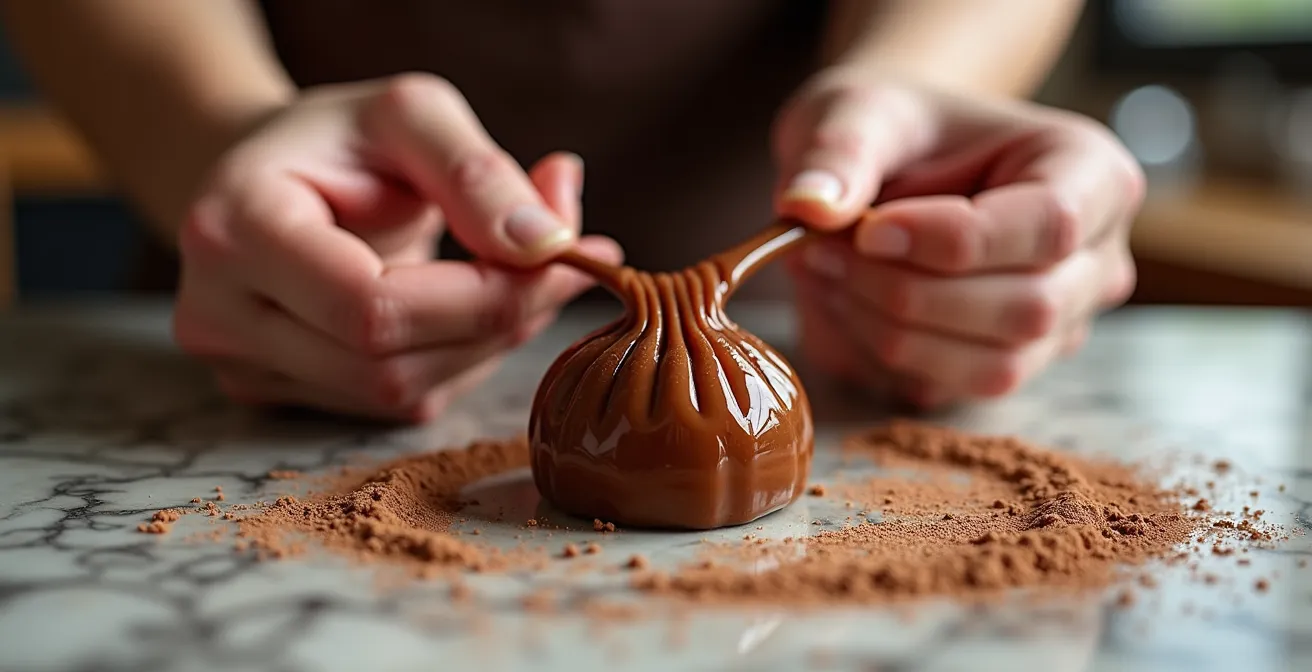
Successfully adding mochi texture to chocolate isn’t about recipes; it’s about mastering the science of textural engineering.
- Flavor balance relies on understanding cultural preferences for sweetness and the chemical properties of ingredients like matcha and yuzu.
- Textural success depends on precise temperature control and managing fat/starch interactions, especially when using ingredients like tahini.
Recommendation: Shift your focus from simply combining ingredients to architecting a cohesive mouthfeel by controlling each component’s properties.
The desire to embed a delightfully chewy, elastic texture within the rich, melting quality of a chocolate dessert is a common ambition for the modern baker. You’ve likely seen mochi-stuffed brownies or a chocolate tart with a surprising, bouncy layer, and wondered how to replicate that magic. The internet is filled with simple recipes, but true fusion is more than just placing one food inside another. Many attempts result in a clunky, disconnected experience—a dense brownie with a tough, isolated piece of mochi, rather than a harmonious new creation. This is because the challenge isn’t one of assembly, but of culinary science.
To get started, it’s crucial to understand what mochi is. It’s a Japanese rice cake made from mochigome, a short-grain glutinous rice. The rice is pounded into a paste and molded. When you see it filled, it’s typically called daifuku. And a key fact for your clientele: despite its name, the glutinous rice used to make mochi is naturally gluten-free. The common pitfall is treating this delicate, high-moisture starch component as a simple “add-in.” To truly succeed, you must think like a fusion pastry chef, considering the interactions of fat, sugar, water, and aromatics at a molecular level.
But if the secret isn’t in the recipe, where is it? The breakthrough comes when you stop thinking about “adding” and start thinking about textural engineering and flavor chemistry. This guide will walk you through the core principles needed to master this craft. We will deconstruct how to balance flavors, manage ingredient quality, control textures with temperature, and understand the very source of your chocolate to create desserts that are more than the sum of their parts. It’s about building a cohesive mouthfeel architecture from the ground up.
This article provides a comprehensive roadmap for mastering the art of chocolate and mochi fusion. The following sections explore everything from cultural flavor preferences to the deep science of ingredient pairing.
Summary: A Chef’s Guide to Mochi and Chocolate Fusion
- Why Do Asian Markets Prefer Less Sweet Chocolate Than American Markets?
- How to Balance the Bitterness of Matcha with White Chocolate Sweetness?
- Mexican Mole vs. Indian Masala: Which Spice Profile Suits Brownies Best?
- The Quality Mistake of Using Drinking Matcha Instead of Culinary Grade
- When to Add Tahini to Ganache for a Halva-Like Mouthfeel?
- Why Do Madagascan Beans Taste Fruitier Than Ghanaian Varieties?
- Yuzu vs. Lemon: Which Acid Cuts Through Milk Chocolate Best?
- Where to Find the Best Bean-to-Bar Workshops in Your City?
Why Do Asian Markets Prefer Less Sweet Chocolate Than American Markets?
Before you even begin mixing, understanding the foundational palate you’re working with is critical. A primary reason Western-style chocolate desserts can feel jarring when paired with Asian ingredients is the vast difference in sweetness expectations. In many Asian culinary traditions, dessert is not the explosive sugar-finale it is in the West. Instead, it’s a moment of subtle balance, often incorporating bitter, savory, or umami notes. As noted in The Rise of Asian Fusion Desserts, this is partly a cultural perspective on wellness.
Rich, sugary foods are often considered ‘heaty,’ leading to a preference for more balanced or bitter flavors.
– Hong Kong Egglet Delivery, The Rise of Asian Fusion Desserts
This preference is directly reflected in professional confectionery. For instance, traditional Japanese confectionery standards reveal that their popular nama chocolate often uses a 2:1 ratio of chocolate to cream. This is significantly less sweet and richer in cocoa flavor compared to the typical Western ganache, which often hovers around a 1:1 ratio. The higher proportion of chocolate delivers a firmer texture and a more pronounced bitterness, designed to be savored rather than overwhelm.
For a baker creating a mochi-chocolate tart, this insight is a game-changer. Instead of using a standard sweet chocolate filling, you should formulate a ganache or mousse with a higher cocoa percentage and reduced sugar. This creates a “flavor bridge” to the delicate, starchy neutrality of the mochi, allowing the two elements to complement each other. The goal is not to make the chocolate less delicious, but to make the entire dessert more cohesive, respecting the principle that balance often triumphs over sheer intensity.
How to Balance the Bitterness of Matcha with White Chocolate Sweetness?
The pairing of matcha and white chocolate is a modern classic, but achieving harmony is a delicate dance of flavor chemistry. White chocolate, with its high sugar and cocoa butter content, can easily overpower matcha’s nuanced, grassy bitterness. Conversely, too much matcha can lend an unpleasant, chalky astringency. The secret lies in treating matcha not as a powder to be simply stirred in, but as a collection of delicate compounds that need to be properly bloomed and emulsified.
The first principle is to respect temperature. High heat is the enemy of quality matcha, causing its chlorophyll to denature and its flavor to turn harsh. To preserve its vibrant color and complex notes, you must manage the compound interaction carefully. The process involves blooming the matcha powder in a fat at a controlled temperature before introducing it to the main body of the white chocolate.
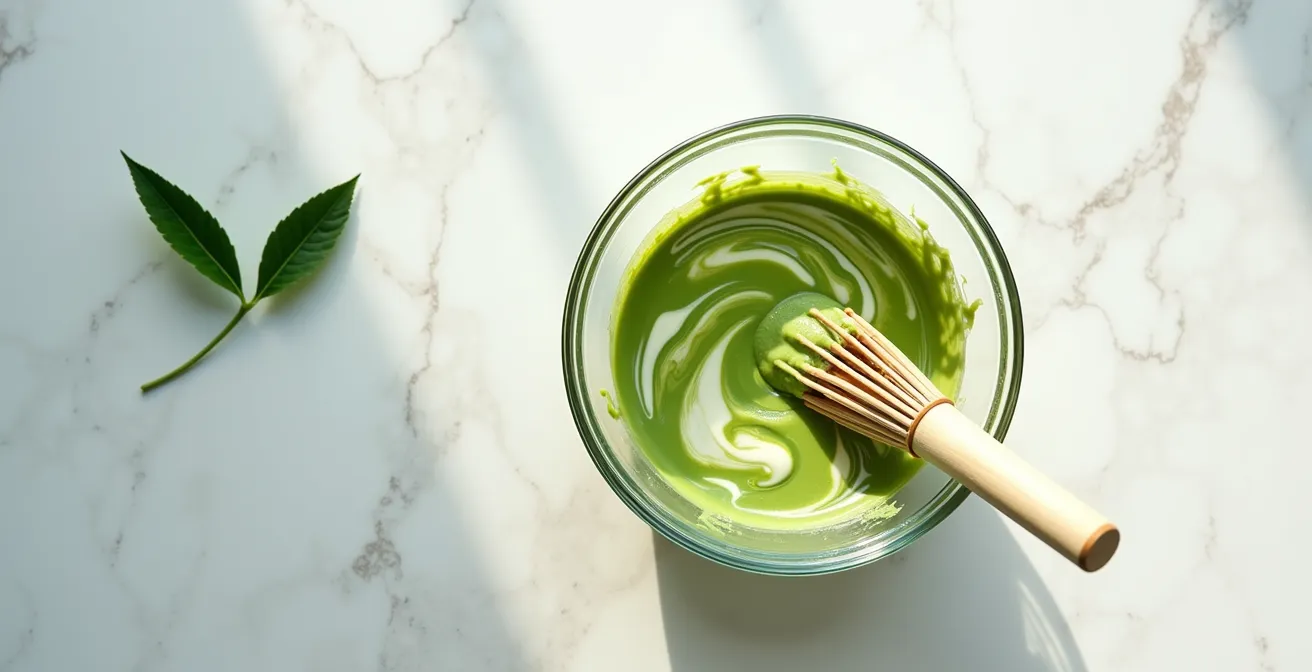
A professional approach involves a multi-step process for a perfect ganache. You’re not just mixing; you’re creating a stable emulsion that respects the properties of both ingredients. A common technique involves:
- Blooming: Gently melt cocoa butter to between 32-35°C (90-95°F) and whisk in the matcha powder. This fat-based blooming prevents scorching and unlocks the matcha’s fat-soluble flavor compounds.
- Ratio Control: For a firm, pipeable ganache, a ratio of approximately 1 part matcha to 10 parts white chocolate is a reliable starting point.
- Straining: Always pass the matcha mixture through a fine-mesh sieve to eliminate any stubborn clumps, ensuring a silky-smooth final texture.
- Incorporation: Once the white chocolate ganache is made and has cooled slightly, the strained matcha slurry is gently folded in. For a mousse or cream, it can be folded into the whipped component at room temperature.
By following these steps, you move from a simple mixture to an engineered fusion. The result is a dessert where the creamy sweetness of the white chocolate elevates, rather than masks, the sophisticated, earthy notes of the matcha.
Mexican Mole vs. Indian Masala: Which Spice Profile Suits Brownies Best?
When introducing a chewy mochi element into a classic brownie, the spice profile of the chocolate itself becomes a crucial tool for creating a unified dessert. Two powerful, complex flavor systems offer intriguing possibilities: the deep, earthy notes of a Mexican mole and the aromatic, bright notes of an Indian masala chai spice blend. The choice between them is not a matter of “better” but of strategy. Are you aiming for a complementary flavor that deepens the chocolate, or a contrasting one that creates an aromatic lift?
Mexican mole, particularly mole poblano, is built around dried chilies, nuts, seeds, and unsweetened chocolate. Its flavor strategy is complementary. The fruity, raisiny notes of ancho and pasilla chilies resonate with the natural fruitiness of the cacao itself, creating a profound, layered chocolate experience. For a brownie, this profile adds moisture and results in a fudgier texture, which can beautifully envelop a soft mochi center. The key is to bloom the fat-soluble spices (like chili powder) in the melted butter to extract their full depth.
Indian masala, on the other hand, is a contrasting strategy. Spices like cardamom, cinnamon, ginger, and clove are highly aromatic. Cardamom, in particular, provides a bright, floral, and almost citrusy lift that cuts through the richness of the chocolate. This creates a more dynamic tasting experience where the spice and chocolate play off each other. These spices are often more water-soluble, making them ideal for infusing into milk or cream before it’s added to the batter. This approach can lead to a slightly more cake-like brownie, where the aromatic steam helps create a lighter crumb that contrasts well with dense, chewy mochi.
This comparative table, based on an analysis of flavor integration, breaks down the strategic differences:
| Aspect | Mexican Mole Profile | Indian Masala Profile |
|---|---|---|
| Flavor Strategy | Complementary – deepens chocolate’s fruity notes | Contrasting – creates aromatic lift with cardamom |
| Texture Impact | Adds moisture, creates fudgier brownie | Slightly absorbs moisture, ideal for cake-like texture |
| Spice Solubility | Fat-soluble (bloom in butter) | Water-soluble (infuse in milk) |
| Ideal Temperature | Medium heat extraction | Low heat preservation |
Case Study: Bridging Traditions
The successful fusion of Western flavor pairings like peanut butter and chocolate with the traditional Japanese mochi texture demonstrates how spice and flavor profiles can bridge culinary traditions. This dessert, a chewy chocolatey square, showcases a cohesive final product where distinct elements become one, proving that a well-chosen profile is the key to unifying disparate ingredients.
The Quality Mistake of Using Drinking Matcha Instead of Culinary Grade
One of the most common and costly mistakes a baker can make is assuming all matcha is created equal. The vibrant, electric-green powder used in traditional Japanese tea ceremonies (ceremonial grade) is a world apart from the one you should be using in your baking (culinary grade). While it might seem like using the “best” grade would yield the best results, in baking, the opposite is true. This choice is a matter of both flavor chemistry and economics.
First, the practical difference: professional chocolatiers recognize that ceremonial matcha costs 3-5x more than culinary grade. This is because it’s made from the youngest, most tender tea leaves, which are stone-ground into an ultra-fine powder. Its flavor is delicate, sweet, and rich in umami, designed to be appreciated on its own with just hot water. Culinary grade matcha, by contrast, is made from slightly more mature leaves, giving it a bolder, more robust, and slightly more bitter flavor profile specifically designed to stand up to other ingredients like fat, sugar, and flour.
The most critical difference, however, is scientific. The delicate chlorophyll compounds that give ceremonial matcha its brilliant color are extremely sensitive to heat. This is a point of deep frustration for bakers who invest in the expensive powder only to be disappointed.
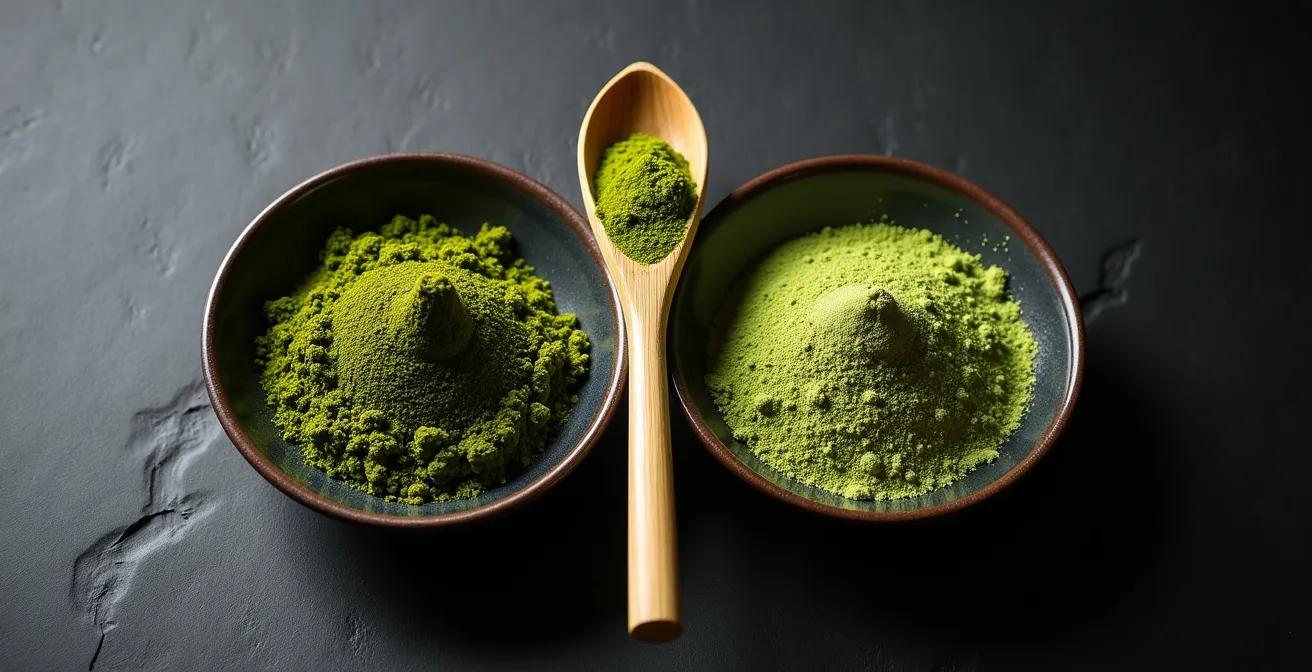
When heated or exposed to fats and sugars, ceremonial grade chlorophyll denatures, turning a ‘swampy’ brown-green.
– Mochi Mommy, Chocolate Stuffed Mochi Guide
This reaction not only ruins the visual appeal of your dessert but also degrades the flavor, replacing the nuanced sweetness with a dull bitterness. Culinary grade matcha has a more stable chlorophyll structure, allowing it to retain a pleasant green hue even after baking. When integrating matcha into a chocolate mochi tart, using culinary grade is non-negotiable for achieving both the desired flavor impact and an appealing aesthetic without breaking the bank.
When to Add Tahini to Ganache for a Halva-Like Mouthfeel?
Introducing tahini into a chocolate ganache to evoke the crumbly, sandy texture of halva is a brilliant exercise in mouthfeel architecture. However, simply stirring sesame paste into melted chocolate will lead to a greasy, separated mess. Tahini is an emulsion of ground sesame seeds and oil, and successfully integrating it into a chocolate ganache—itself a fragile emulsion of cocoa solids, cocoa butter, and cream—requires precise temperature control. The key moment is when both emulsions are in a similar state, ready to be combined without breaking.
The cardinal rule is to never add cold tahini to hot ganache, or vice-versa. The thermal shock will cause the fats to separate instantly. The ideal integration window is when the base chocolate ganache has cooled to a range of 35-40°C (95-104°F). At this temperature, the cocoa butter in the ganache is still fluid but beginning to set, making it receptive to another fat. The tahini should be gently warmed to this same temperature range before being folded in.
The ratio is also critical. A good starting point is adding tahini at about 15% of the total ganache weight. This is enough to impart the distinct nutty flavor and the signature micro-grittiness of halva without compromising the ganache’s structure. Overmixing is the final enemy; fold the tahini in gently with a spatula only until it is just combined. Over-agitation can break the emulsion and smooth out the very texture you’re trying to create.
Case Study: Multi-Component Mochi Success
Professional mochi makers demonstrate successful emulsion management by layering different components. By creating a dessert with rich chocolate, silky ganache, and surprising textural contrasts from elements like whipped cream, they show how to build a complex yet cohesive experience. The success lies in how each layer is prepared and stabilized before being combined, ensuring that the final dessert melts in your mouth with distinct, intentional textures.
Action Plan: Auditing Your Textural Integration
- Temperature Synchronization: Have you planned to bring both the base ganache and the textural add-in (like tahini) to a precise, identical temperature range (e.g., 35-40°C) before combining?
- Ratio Calculation: Is your add-in calculated as a specific percentage of the base’s total weight (e.g., 15% tahini) to ensure structural integrity?
- Emulsion Stability: Have you included a stabilizing agent, such as a small amount of glucose syrup or invert sugar (e.g., 1 tsp per 200g), in your ganache formula to prevent splitting?
- Mixing Technique: Does your method specify a gentle folding technique with a spatula rather than aggressive whisking to preserve the desired final texture and prevent over-aeration?
- Cooling & Setting Protocol: Have you defined a controlled cooling process (e.g., room temperature setting before refrigeration) to allow the new, complex emulsion to set properly without shocking it?
Why Do Madagascan Beans Taste Fruitier Than Ghanaian Varieties?
For a pastry chef working at the crossroads of flavor, understanding that not all chocolate is the same is paramount. The origin of the cacao bean dictates its fundamental flavor profile, which dramatically influences how it will pair with other ingredients like mochi. A classic example is the difference between beans from Madagascar and Ghana. Madagascan chocolate is renowned for its bright, red-fruit acidity, while Ghanaian chocolate is known for its classic, robust “chocolatey” flavor.
The primary reason for this difference lies in genetics. Genetic analysis shows that Madagascan cacao is predominantly a mix of Trinitario and the rare, prized Criollo varieties, which account for about 70% of its crop. These varieties are genetically predisposed to developing complex, fruity, and floral flavor notes. In stark contrast, Ghana, one of the world’s largest cocoa producers, cultivates almost exclusively the Forastero variety (around 90%). Forastero is a hardier, higher-yielding bean known for its straightforward, bitter, and rich cocoa flavor.
However, genetics are only part of the story. The post-harvest processing, particularly fermentation, is where these inherent potentials are unlocked. Producers in Madagascar have perfected their methods to enhance these fruity notes. As experts from NoRecipes explain, specific techniques are used to encourage the growth of certain yeasts and bacteria during fermentation.
Fermentation protocols are tailored to develop acetic acid, a precursor to fruity notes.
– NoRecipes, Professional Chocolate Analysis
This controlled development of acetic acid is what creates the vibrant, berry-like tang that makes Madagascan chocolate so distinctive. When pairing with a neutral mochi, using a Madagascan 65-70% dark chocolate can create a stunning dessert where the chocolate itself provides the acidic, fruity counterpoint. Using a Ghanaian chocolate would create a more classic, comforting profile. Knowing this allows a chef to choose their chocolate not just by percentage, but by its intrinsic flavor profile, making the bean itself an active ingredient in the final flavor architecture.
Yuzu vs. Lemon: Which Acid Cuts Through Milk Chocolate Best?
Acidity is a powerful tool for a pastry chef, capable of cutting through the richness of fats and sugars to bring balance and brightness to a dessert. When working with a creamy, sweet milk chocolate, a citrus element is often the perfect foil. But a common question in fusion pastry is whether to use a familiar lemon or the more complex, aromatic yuzu. While both are acidic, their chemical composition and interaction with fat are fundamentally different, making yuzu a far superior choice for sophisticated chocolate pairings.
A lemon’s power comes almost entirely from a single compound: citric acid. This provides a sharp, direct, and refreshing sourness. It’s highly water-soluble, meaning its flavor primarily interacts with the aqueous components of a dish. When added to a fatty medium like milk chocolate ganache, its effect can be one-dimensional—a simple, sharp contrast.
Yuzu, a Japanese citrus, offers a much more complex approach. Its profile is a dual-action of both water-soluble citric acid and, crucially, highly aromatic, fat-soluble compounds like yuzunone and limonene, which are concentrated in its zest. Because chocolate is a fat-based medium, these oil-based aromatics dissolve into and merge with the cocoa butter, creating an entirely new, complex “third flavor” that is both floral and citrusy. It doesn’t just contrast with the chocolate; it integrates into it. This is the essence of superior flavor chemistry.
This table highlights the key differences in their properties and application:
| Property | Yuzu | Lemon |
|---|---|---|
| Primary Compounds | Yuzunone + Limonene (dual action) | Citric acid (singular) |
| Fat Solubility | High (oil-based aromatics) | Low (water-based acid) |
| Flavor Interaction | Creates complex ‘third flavor’ | Direct contrast only |
| Optimal Form | Zest + juice combination | Juice primarily |
For a baker adding a mochi element to a milk chocolate tart, using yuzu zest during the chocolate tempering phase allows its aromatic oils to infuse the fat directly. The juice can then be used in a finishing glaze or a separate component to provide a sharp acidic kick. This two-pronged approach creates a multi-layered citrus experience that a simple lemon cannot replicate.
Key Takeaways
- Successful fusion pastry is about science, not just assembly. Focus on textural engineering and flavor chemistry.
- Ingredient quality and type (e.g., culinary vs. ceremonial matcha) are non-negotiable for achieving the desired flavor and color.
- Precise temperature control is the most critical factor when creating complex emulsions with ingredients like chocolate, cream, and tahini.
Where to Find the Best Bean-to-Bar Workshops in Your City?
After exploring the deep science of flavor and texture, the logical next step is to put theory into practice. Reading about tempering temperatures and fermentation protocols is one thing; feeling the chocolate “seize” and then bringing it back into a glossy emulsion is another. The best way to develop this intuitive understanding is through a hands-on, bean-to-bar workshop. These classes move beyond simply melting and molding and teach you the full process, from roasting raw cacao beans to grinding, conching, and tempering your own unique chocolate.
Finding a quality workshop, however, requires a discerning eye. The market is filled with “chocolate experiences” that are more entertainment than education. A true bean-to-bar workshop should be transparent about its process and focused on craft. Look for programs that provide individual workstations equipped with professional tools like stone grinders (melangers) and dedicated tempering machines. This ensures you are learning transferable skills, not just watching a demonstration.
Furthermore, investigate the workshop’s philosophy. Do they focus on single-origin tasting, where the goal is to understand and highlight the unique terroir of beans from different regions? Or do they emphasize creative blending, teaching you how to build a signature flavor profile by combining different origins? Both are valuable, but you should choose one that aligns with your personal goals. As noted by experts at Just One Cookbook, the most advanced workshops often sit at a fascinating culinary crossroads.
The best workshops combine traditional Japanese precision with Western innovation techniques.
– Just One Cookbook, Japanese Desserts Guide
When searching, use keywords like “bean-to-bar workshop,” “chocolate making class,” and “cacao lab” for your city. Scrutinize the course descriptions for red flags, such as using pre-made chocolate liquor (which skips the entire grinding and conching process), having class sizes over 10-12 people (which limits personal attention), or a lack of transparency about where their cacao beans are sourced. A great workshop is proud of its supply chain and eager to share the story behind the beans.
Frequently Asked Questions on Bean-to-Bar Workshops
What equipment should a quality workshop provide?
A quality workshop should provide access to professional-grade equipment that goes beyond basic kitchen tools. Look for stone grinders (melangers) for refining the chocolate, dedicated tempering machines for precise temperature control, and individual workstations that allow for a hands-on experience.
How can I identify the workshop’s focus?
Read the workshop description carefully. A “Single-Origin” focused workshop will emphasize tasting and understanding the unique flavor notes of beans from specific regions (terroir). A “Creative Blending” workshop will focus more on the art of combining different beans to create a unique, signature flavor profile.
What are red flags in workshop descriptions?
Be wary of workshops that use pre-made chocolate liquor or couverture, as this skips the most critical parts of the bean-to-bar process. Other red flags include very large class sizes (over 12 participants), which limit individual instruction, and a lack of transparency about the sourcing of their cacao beans.