In summary:
- Success lies in managing temperature and technique to control volatile compounds, not just following a recipe.
- Cold infusion is the superior method for delicate teas like Earl Grey, as it selectively extracts aroma while leaving bitter tannins behind.
- The stability and longevity of your flavor depend on scientific principles like water activity and proper crystallization.
- Even perfect infusions can be muted if the final chocolate is served too cold, preventing aromas from being released.
For any tea lover who has ventured into creating a sophisticated flavored ganache, the disappointment is a familiar one. You start with exquisite Earl Grey and fine chocolate, dreaming of a fragrant, elegant confection. Yet, the result is often a shadow of that dream: either the delicate bergamot notes have vanished, or worse, they’ve been replaced by an aggressive, mouth-puckering bitterness. The common advice is to simply steep tea in hot cream, but this method is a gamble that frequently backfires, extracting unpleasant tannins along with the desired aromas.
This approach treats flavor infusion as a simple mixing exercise, ignoring the complex science at play. The real craft isn’t in the ingredients themselves, but in the precise control of the invisible world of aromatic molecules. These volatile compounds are delicate, elusive, and highly sensitive to their environment. They can be destroyed by heat, trapped by cold, or overpowered by unwanted elements from the same botanical source.
But what if the key to unlocking pure, vibrant flavor wasn’t about steeping harder, but smarter? What if you could selectively extract only the beautiful aromas and leave the bitterness behind? This guide moves beyond the simplistic hot-cream method to explore the science of aromatic preservation. We will delve into temperature control, advanced techniques like cold infusion and enfleurage, and the chemical principles that dictate whether your final creation is a masterpiece of flavor or a bitter disappointment. By understanding the ‘why’ behind the ‘how’, you can finally capture the true soul of your ingredients in every bite.
For those who prefer a condensed visual format, the following video offers a look at a basic cream infusion process, which serves as a foundation for the more advanced techniques we’ll explore in this guide.
To help you navigate these expert techniques, this article breaks down the science of flavor infusion into distinct, manageable principles. The following summary outlines the key stages of our exploration, from the moment of tasting back to the foundational methods of extraction.
Summary: Mastering the Science of Aromatic Chocolate
- Why Do You Lose Aromatic Notes If You Eat Chocolate Too Cold?
- How to Scent Chocolate with Jasmine Flowers Without Direct Contact?
- Essential Oils vs. Zest: Which Citrus Source Lasts Longer in Bonbons?
- The Temperature Mistake That Evaporates Delicate Fruit Notes Instantly
- When to Add Spices: During Melting or Tempering for Better Release?
- How to Infuse Vanilla into Cream in 2 Hours Using Sous-Vide?
- Cold Infusion vs. Hot Infusion: Which Preserves Fresh Herb Notes Best?
- Blue Cheese and Dark Chocolate: Why Does This Bizarre Pairing Work?
Why Do You Lose Aromatic Notes If You Eat Chocolate Too Cold?
The final, crucial step in flavor perception happens not in the kitchen, but in the mouth. You can create a perfectly infused ganache, but if it’s served straight from the refrigerator, its aromatic complexity will be completely lost. The reason lies in the physics of volatile compounds and the nature of cocoa butter. These aroma molecules are “volatile” because they need to evaporate and travel up to the olfactory receptors in your nose to be perceived as flavor. When chocolate is cold (below 10°C), these compounds are essentially locked in place within the solid fat structure.
Cocoa butter is designed to melt optimally around body temperature (34-38°C or 93-100°F). This is no coincidence; it’s what creates the luxurious, melting sensation of fine chocolate. As the chocolate warms and melts on the tongue, the cocoa butter releases its hold on the volatile compounds, allowing them to vaporize. This is why a piece of chocolate that tastes flat and waxy when cold can suddenly bloom with complex notes of fruit, spice, or tea as it warms.
For an optimal tasting experience, chocolate should be stored at a cool room temperature (18-20°C) and allowed to warm slightly in the hand or on the palate before chewing. This small temperature shift is the difference between sensing a simple sweet, bitter taste and experiencing the full, intended aromatic profile that you worked so hard to create. Serving chocolate too cold is the final, and most common, mistake that silences its flavor.
How to Scent Chocolate with Jasmine Flowers Without Direct Contact?
Infusing the ethereal scent of jasmine into chocolate presents a unique challenge: the flowers are so delicate that direct heat or moisture would destroy their aroma and introduce unwanted vegetal notes. The solution comes from the world of perfumery, an elegant technique known as enfleurage. This method leverages the natural ability of fats—in this case, cocoa butter in the chocolate—to absorb ambient aromatic compounds from the air without any physical contact.
The process involves creating a sealed, fragrant environment. Chocolate wafers or shavings are arranged on racks within an airtight container. Fresh, highly aromatic jasmine flowers are placed on separate layers below or alongside the chocolate, ensuring they never touch. The container is then sealed and left in a cool, dark place (around 18-20°C) for 48 to 72 hours. During this time, the jasmine flowers release their volatile oils into the enclosed air, and the fat in the chocolate slowly but surely absorbs them. The flowers may need to be replaced with a fresh batch every 24 hours to intensify the infusion.
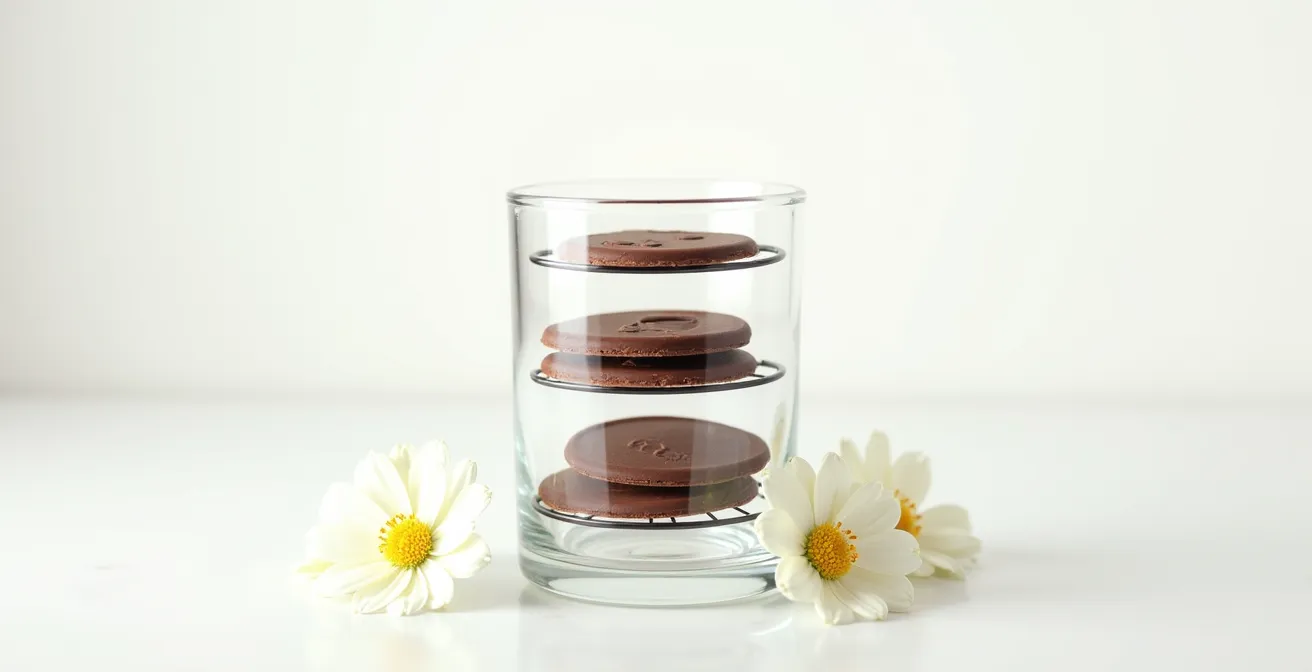
This gentle, passive infusion is the key to capturing the truest, most delicate floral notes. It avoids the pitfalls of heat and moisture, resulting in a chocolate that is purely and cleanly scented with the essence of jasmine. It’s a testament to the fact that the most powerful infusions are often the most patient and indirect, relying on the quiet migration of molecules through the air.
Essential Oils vs. Zest: Which Citrus Source Lasts Longer in Bonbons?
When infusing citrus flavor, chocolatiers face a choice between using fresh zest and concentrated essential oils. While fresh zest provides a bright, immediate aroma, it comes with a significant drawback: a drastically reduced shelf life. The culprit is water activity (aW), a measure of the unbound water in an ingredient that is available for microbial growth. Fresh zest has a high water activity, which introduces moisture into a ganache and can lead to spoilage in just a few days.
Food-grade essential oils, on the other hand, are pure lipids with virtually zero water activity. This makes them far more stable. As the celebrated chocolatier Frédéric Bau of L’École Valrhona notes, this characteristic is paramount for professional-quality confections. In his “The Encyclopedia of Chocolate,” he explains:
Food-grade essential oils are pure lipids with zero water activity, ensuring stability in ganache for months
– Frédéric Bau, The Encyclopedia of Chocolate, L’École Valrhona
This difference in stability is critical for any bonbon intended to last more than a week. The following table, based on professional stability analysis, clearly shows how different citrus sources impact shelf life.
| Citrus Source | Shelf Life | Water Activity | Stability Rank |
|---|---|---|---|
| Essential Oil | 6-12 months | 0.0 aW | 1 (Most stable) |
| Zest in cocoa butter | 3-6 months | 0.1 aW | 2 |
| Oleo-saccharum | 2-3 months | 0.3 aW | 3 |
| Candied zest | 1-2 months | 0.5 aW | 4 |
| Fresh zest | 3-7 days | 0.8 aW | 5 (Least stable) |
While fresh zest offers an unmatched fresh-squeezed character for immediate consumption, for any application requiring stability, essential oils are the superior professional choice. They deliver potent, consistent flavor without compromising the ganache’s integrity or shelf life.
The Temperature Mistake That Evaporates Delicate Fruit Notes Instantly
Fruit purees are a wonderful way to bring vibrant, tangy notes to chocolate, but they contain some of the most fragile aromatic compounds in the confectioner’s pantry. The bright, fresh top notes of raspberry, passion fruit, or strawberry are carried by delicate molecules called esters. These esters are extremely volatile and sensitive to heat. The single biggest mistake a chocolatier can make is overheating the ganache after the fruit puree has been added.
Scientific studies show that these delicate fruit esters begin to evaporate rapidly at temperatures as low as 60-70°C (140-158°F). If you combine your cream and chocolate and the mixture is too hot when you incorporate the fruit puree, you are effectively boiling off the very aromas you want to capture. The result is a ganache that tastes flat, cooked, or jammy, lacking the fresh, zesty character of the original fruit.
The correct technique is to create the ganache emulsion first and allow it to cool to a safe temperature—ideally below 40°C (104°F)—before gently folding in the fruit puree. This ensures that the emulsion is stable but the temperature is low enough to preserve the fragile esters. By respecting this temperature ceiling, you protect the volatile top notes, resulting in a finished product that bursts with fresh, authentic fruit flavor. Ignoring it is a guaranteed way to lose the soul of your fruit infusion.
When to Add Spices: During Melting or Tempering for Better Release?
The timing of when you introduce spices into your chocolate is critical and depends entirely on the type of spice and the flavor profile you wish to achieve. Adding spices at the wrong stage can either result in a weak, undeveloped flavor or, worse, ruin the chocolate’s texture by disrupting its crystallization during tempering.
There are two primary professional methods for infusing spices:
- Blooming in Fat (for ground spices): Spices like cinnamon, nutmeg, or cardamom contain oil-soluble flavor compounds. To extract these effectively, they should be gently “bloomed” in melted cocoa butter or the hot cream intended for the ganache. Heating them briefly (e.g., at 45°C for 30-60 seconds) unlocks their aromatic oils. This infused fat or cream should then be strained through a fine-mesh sieve before being incorporated into the chocolate. This prevents a gritty texture.
- Steeping in Liquid (for whole spices): Whole spices like star anise, cloves, or vanilla beans release their flavor best when steeped in a liquid. They should be added to the cream, brought to a near-simmer, and then allowed to infuse off the heat for at least 20 minutes before being strained out.
Crucially, ground spices should never be added directly to chocolate during the tempering phase. The fine particles act as foreign bodies that can interfere with the formation of stable beta V crystals, preventing the chocolate from setting with the proper snap and shine. Spice-infused ingredients (like strained cream or butter) should only be added once the chocolate is at its final working temperature (around 31-32°C for dark chocolate), ensuring the temper is not broken.
Your Action Plan: Professional Spice Infusion Protocol
- Bloom ground spices in melted cocoa butter at 45°C for 30-60 seconds to release oil-soluble flavors.
- For whole spices, add them to cream, heat gently, and let them infuse off the heat for a minimum of 20 minutes.
- Always strain the infused liquid (cream or butter) through a fine-mesh sieve to remove all solid particles before adding it to the chocolate.
- Never add dry, ground spices directly during the tempering phase, as this will disrupt the chocolate’s crystal structure.
- Incorporate your strained, spice-infused liquid only when the chocolate has cooled to its final working temperature (e.g., 31-32°C) to maintain a perfect temper.
How to Infuse Vanilla into Cream in 2 Hours Using Sous-Vide?
Traditional methods for infusing vanilla into cream, which involve gently heating and steeping, are effective but can be inconsistent and time-consuming. For chocolatiers seeking precision and unparalleled flavor extraction, the sous-vide technique offers a revolutionary alternative. By cooking the cream and vanilla in a vacuum-sealed bag at a precise, stable temperature, you can achieve a depth of flavor in a fraction of the time.
The science behind its efficiency is clear: the sealed environment prevents any volatile aromatic compounds from escaping, forcing them directly into the cream. Furthermore, the sustained, precise heat allows for a more thorough extraction of vanillin and other complex flavor molecules from the pod. Research and professional application have shown that sous-vide extraction can yield significantly more flavor compounds compared to traditional steeping methods.
The process is remarkably straightforward yet requires precision. The cream and a split vanilla pod are sealed in a vacuum bag and submerged in a water bath controlled by a precision cooker. The key is setting the correct temperature and time for the desired flavor profile.
- For a robust, deep infusion: Set the cooker to 85°C (185°F) and infuse for exactly 2 hours.
- For a more delicate, nuanced profile: Use a lower temperature of 75°C (167°F) and extend the infusion to 4 hours.
Once the infusion time is complete, it’s critical to immediately transfer the bag to an ice bath. This “shocking” process rapidly cools the cream, locking in the volatile aromas that would otherwise escape as steam. The result is a vanilla-infused cream with an intensity and complexity that is difficult to achieve with a stovetop alone.
Cold Infusion vs. Hot Infusion: Which Preserves Fresh Herb Notes Best?
This brings us to the heart of the problem posed in our title: how to capture the delicate aroma of Earl Grey tea without extracting its bitter tannins. The answer lies in understanding the profound difference between hot and cold infusion. The common method of steeping tea in hot cream is a non-selective process. Heat is an aggressive solvent; it extracts everything it can, including the desirable bergamot oils, but also the undesirable, water-soluble polyphenols known as tannins, which are responsible for bitterness and astringency.
Cold infusion, by contrast, is a method of selective extraction. By steeping the tea leaves (or fresh herbs like mint and basil) in a cold liquid (cream or water) in the refrigerator for an extended period (24-48 hours), you change the rules of extraction. The cold temperature is ideal for gently coaxing out the delicate, fat-soluble volatile oils responsible for aroma. However, it is not effective at dissolving the larger, more robust tannin molecules. This is why cold-brewed coffee and tea are noticeably smoother and less bitter than their hot-brewed counterparts.
As detailed in case studies on botanical extraction, this temperature-selective process is the key to clean flavor. A cold infusion at 3-5°C (37-41°F) selectively extracts the volatile essential oils while leaving behind the bitter compounds like tannins and chlorophyll. The result is a pure, vibrant infusion that captures the fresh top notes of the ingredient without the “cooked” or bitter background noise. For Earl Grey ganache, this means you get all the fragrant bergamot with none of the tannic bite. It requires patience, but the superior quality of the final flavor is undeniable.
Key takeaways
- Flavor is science: Success depends on controlling volatile compounds through precise temperature and technique.
- Temperature is everything: Aromas are muted when cold and destroyed when too hot. Every ingredient has a specific “safe zone.”
- Gentle is better: Indirect methods like enfleurage and patient techniques like cold infusion yield purer, cleaner flavors by avoiding the extraction of unwanted compounds like tannins.
Blue Cheese and Dark Chocolate: Why Does This Bizarre Pairing Work?
On the surface, the pairing of pungent, funky blue cheese and rich, dark chocolate seems bizarre, even unappetizing. Yet, for those who have tried it, the combination can be surprisingly harmonious. This isn’t just a random success; it’s a perfect illustration of a core principle in advanced food pairing: the power of a shared aromatic link. The magic happens at a molecular level, where both ingredients contain similar types of flavor compounds that our brain perceives as a unified, pleasing experience.
Fermented cocoa beans and aged blue cheeses like Roquefort or Stilton both undergo complex chemical transformations that produce a range of volatile molecules, including specific esters and ketones. When our olfactory system detects these same compounds in both foods simultaneously, it creates a bridge between them. As experts at the Callebaut Chocolate Academy explain, this molecular bridge is what turns a potential clash into a sophisticated harmony. This proves that successful pairings are often based on shared aromatic profiles rather than simple contrasting or complementary tastes.
Integrating such a bold pairing can be done in several ways, each offering a different experience:
| Method | Integration | Stability | Flavor Profile |
|---|---|---|---|
| Contained pairing | Small cheese piece in bonbon | 5-7 days | Distinct contrast |
| Homogenized infusion | Cheese infused in cream, strained | 10-14 days | Smooth, integrated |
| Surface application | Cheese crumble on bar | 2-3 days | Textural variety |
This “bizarre” pairing is the ultimate proof of the principles discussed. It shows that by understanding the molecular components of flavor, a chocolatier can move beyond conventional combinations and create truly innovative and memorable experiences, all guided by science.
Now that you are equipped with the scientific principles of flavor infusion, from temperature control to selective extraction, the next step is to apply this knowledge. Start by rethinking your approach to a familiar ingredient, perhaps by attempting a cold infusion of Earl Grey, and notice the profound difference in the final product. Your journey from cook to flavor artist begins with that first controlled experiment.