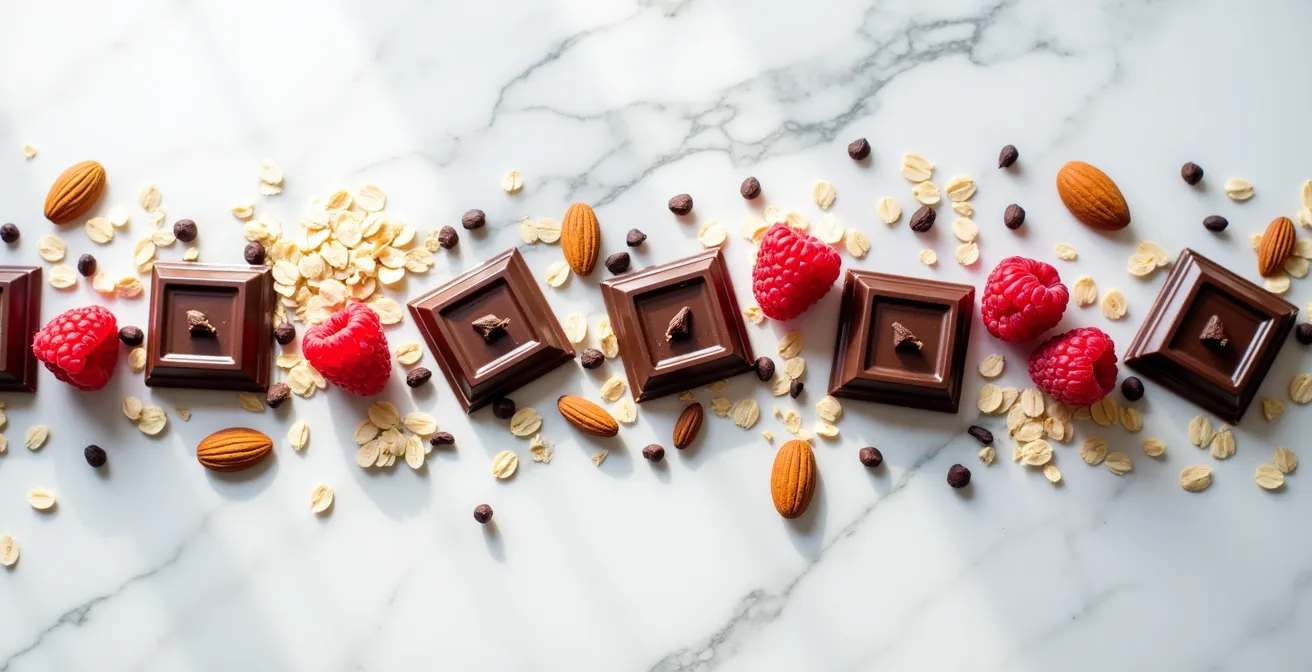
Contrary to popular belief, the key to enjoying chocolate without derailing your diet isn’t stricter rules, but a smarter strategy that works with your brain’s reward system, not against it.
- Banning treats often backfires, leading to psychological restriction and eventual binge eating.
- The type of treat and how you eat it matters more than the calories alone; some sustain energy while others cause a crash.
Recommendation: Shift your focus from “avoiding” chocolate to strategically “using” it to manage cravings, boost satisfaction, and sustain energy, turning it from a liability into an asset for your diet’s longevity.
The fear is palpable for any dedicated weight watcher. You’ve been disciplined, you’ve seen progress, and then it appears: a craving for dark chocolate. The internal debate begins. Is one small square an innocent pleasure or the first step on a slippery slope that unravels all your hard work? Many diets are built on a foundation of restriction, categorizing foods as “good” or “bad.” This all-or-nothing thinking turns chocolate into a forbidden fruit, a source of guilt and anxiety. The common advice is to “eat in moderation,” but what does that truly mean when the fear of losing control is so strong?
You might have tried substituting with “healthy” snacks that never quite hit the spot, or tried to ignore the craving with sheer willpower, only to find it roaring back with a vengeance days later. This cycle of restriction, craving, and potential binging is exhausting and, more importantly, unsustainable. It’s the very reason so many diets fail. The problem isn’t the chocolate itself, but the framework of deprivation we build around it. What if the solution wasn’t to fight the craving, but to understand and manage it? What if you could make that square of dark chocolate a planned, functional, and deeply satisfying part of your balanced lifestyle?
This guide moves beyond the simple “eat less” mantra. As a diet sustainability coach, I’ll show you how to reframe your relationship with treats. We will explore the psychological trap of banning foods and provide concrete strategies to make chocolate work for you, not against you. We’ll delve into how to choose treats that sustain energy, how to maximize satisfaction from smaller portions, and how to become a savvy consumer who can spot hidden sugars. This is your roadmap to integrating dark chocolate sustainably, turning fear into empowerment and guilt into guilt-free enjoyment.
To help you navigate this new approach, this article breaks down the essential strategies for making dark chocolate a sustainable part of your healthy lifestyle. The following sections provide a clear path from understanding the psychology of cravings to implementing practical, daily habits.
Summary: A Guide to Guilt-Free Dark Chocolate Integration
- Why Does Banning Chocolate Lead to Binge Eating Later?
- How to Swap an Afternoon Latte for a Cocoa Drink to Reduce Calories?
- Chocolate Covered Almonds vs. Pretzel: Which Sustains Energy Longer?
- The Mistake of Eating the Same Treat Daily That Reduces Satisfaction
- When to Add Cacao Nibs to Oatmeal for Crunch and Magnesium?
- How Small Can a ‘Bite-Sized’ Treat Be Before It Feels Stingy?
- How to Spot Hidden Sugars in ‘Healthy’ Dark Chocolate Bars?
- The ’20-Minute Rule’ That Helps You Stop Eating Sweets at the Right Time
Why Does Banning Chocolate Lead to Binge Eating Later?
The impulse to completely ban “bad” foods like chocolate during a diet feels logical, but it often creates a powerful psychological backlash. This phenomenon, known as dietary restriction, can paradoxically increase the desire for the very food you’re trying to avoid. When you label a food as forbidden, you elevate its status, making it seem more desirable and occupy more of your mental energy. This isn’t a failure of willpower; it’s a predictable human response. In fact, research from UCSD shows that people who chronically restrict their food intake become biologically more sensitive to food rewards and psychologically more vulnerable to stress-induced cravings.
This creates a vicious cycle. The longer you restrict, the more intense the craving becomes. When you finally “give in,” it often doesn’t feel like a moderate choice but a transgression. This sense of failure can trigger an “all-or-nothing” mindset: “I’ve already ruined my diet, so I might as well finish the whole bar.” This is the restriction-binge pendulum in action. The initial ban sets the stage for a loss of control, followed by intense guilt, which then fuels the resolve to restrict even more harshly, starting the cycle anew. The key to breaking free is to move away from banning and towards planned inclusion. As Kristin Javaras, an assistant professor of psychiatry at Harvard Medical School, noted in her research on eating behaviors:
Addressing restriction — getting people to eat regularly — is one of the most potent interventions.
– Kristin Javaras, Harvard Gazette
By allowing yourself a small, planned portion of dark chocolate, you neutralize its power. It’s no longer a forbidden temptation but just another food. This shift in mindset is fundamental to building a sustainable, long-term relationship with food where you are in control, not your cravings. It transforms the act of eating chocolate from a moment of weakness into a conscious, guilt-free decision.
How to Swap an Afternoon Latte for a Cocoa Drink to Reduce Calories?
The 3 PM slump often sends us reaching for a comforting, energy-boosting drink. For many, this means a cafe latte or a flavored coffee beverage, which can be laden with sugar and hundreds of calories, quietly sabotaging your diet goals. A strategic and satisfying alternative is a homemade functional cocoa drink. Unlike many commercial hot chocolates, a carefully prepared cocoa drink provides the rich flavor and psychological comfort you crave without the high caloric price tag. The key is to control every ingredient, turning your treat into a functional indulgence.
Using unsweetened cacao powder as your base is crucial. Cacao is packed with theobromine, a mild stimulant that provides a smoother, less jittery energy lift than caffeine. It’s also a source of antioxidants and mood-boosting compounds. By swapping the high-fat milk and sugary syrups of a typical latte for unsweetened almond milk and natural spices, you create a beverage that actively supports your goals. This isn’t about deprivation; it’s a smart upgrade. You get the warm, rich experience while significantly cutting down on calories and sugar, making it a habit you can sustain without guilt.
To make this swap effective, think like a mixologist. The process below allows you to build a drink perfectly tailored to your needs, whether you need blood sugar stabilization or a sustained energy boost. This hands-on approach also fosters a mindful connection with your food.

The beauty of this approach, as seen in the preparation, lies in its simplicity and customizability. Instead of relying on a pre-made mix, you are in complete control. Here is a simple formula to create your own functional cocoa drink:
- Choose Your Base: Start with 1 cup of unsweetened almond milk or even water to keep calories at their lowest.
- Add the Cacao: Whisk in 1-2 tablespoons of unsweetened cacao powder for rich flavor and theobromine benefits without the jitters.
- Mix in Functional Boosters: Add a dash of cinnamon to help with blood sugar regulation or a teaspoon of maca powder for sustained, non-caffeinated energy.
- Control the Sweetness: If needed, use a minimal amount of a natural sweetener like a few drops of stevia or a tiny teaspoon of maple syrup, measuring carefully.
- Heat and Enjoy: Gently heat the mixture in a saucepan or the microwave, stirring well. Sip slowly and mindfully.
Chocolate Covered Almonds vs. Pretzel: Which Sustains Energy Longer?
When a snack craving hits, the choice you make can dramatically impact your energy levels and hunger for the rest of the day. It’s not just about calories, but about how your body processes the food. A common mistake is reaching for a carbohydrate-heavy, low-fiber snack like pretzels. While they provide a quick burst of energy, they also cause a rapid spike in blood sugar, followed by an inevitable crash that leaves you feeling tired, unfocused, and often craving more sugar. This is a classic example of a snack that works against your goals.
In contrast, a small handful of dark chocolate-covered almonds offers a completely different metabolic experience. This choice provides a powerful trio of protein, healthy fats, and fiber from the almonds. This combination slows down the absorption of sugar (from the chocolate) into your bloodstream, preventing the sharp spike and crash. The result is a much more stable and sustained release of energy that keeps you feeling full and focused for hours. This concept is measured by the Glycemic Index (GI), which ranks foods on how they affect blood sugar levels. Pretzels have a very high GI, while almonds have a very low one.
Making this strategic snack swap is a core principle of diet sustainability. You’re still getting the satisfying crunch and a touch of chocolatey sweetness, but you’re pairing it with nutrients that support stable energy and satiety. The following table, based on an analysis of the glycemic impact of different foods, clearly illustrates why one choice sustains you while the other sets you up for another craving.
| Snack Type | Glycemic Index | Protein (per oz) | Fiber (per oz) | Energy Duration |
|---|---|---|---|---|
| Dark Chocolate Almonds | <15 | 6g | 3.5g | 3-4 hours |
| Pretzels | 83 | 2.5g | 1g | 30-60 minutes |
| Chocolate Chickpeas (bonus) | 28 | 6g | 5g | 2-3 hours |
Choosing dark chocolate almonds over pretzels isn’t about restriction; it’s about choosing a smarter tool for the job of managing your energy and hunger. This is how a treat becomes a functional part of your day, not just an empty-calorie indulgence.
The Mistake of Eating the Same Treat Daily That Reduces Satisfaction
Have you ever noticed that the first bite of a treat is always the best? Or that a dessert you once loved starts to feel less special when you have it every day? This isn’t your imagination; it’s a well-documented psychological principle called hedonic adaptation. Essentially, our brains are wired to get used to positive experiences, causing them to provide diminishing returns in pleasure over time. When you eat the exact same square of 70% dark chocolate every single afternoon, your reward system starts to anticipate it, and the novelty—and therefore a significant portion of the satisfaction—wears off.
This is a critical mistake for anyone trying to sustainably manage a diet. If your planned daily treat becomes less satisfying, you’re more likely to feel deprived and start seeking more—a larger portion, or a different, “more exciting” snack—to get the same pleasure boost. This is how a controlled, 100-calorie habit can slowly escalate into a 300-calorie problem. The solution isn’t to eliminate the treat, but to outsmart hedonic adaptation by intentionally introducing variety and mindfulness into your routine.
Case Study: Overcoming Hedonic Adaptation
A 2024 study on repeat consumption and satisfaction found that participants who ate the same chocolate repeatedly reported a significant drop in enjoyment. However, the decline in satisfaction was much smaller for a group that was instructed to apply “cognitive flexibility.” By consciously focusing on different aspects of the treat with each bite—such as the texture, the changing flavor notes as it melted, or the sound it made—they were able to keep their satisfaction levels higher over time. This shows that how you *think* about your treat is as important as what you eat.
To put this into practice, create a simple rotation for your chocolate moments. By varying the percentage of cacao, the form of the chocolate, or how you eat it, you keep the experience novel and your brain engaged. This prevents the satisfaction from fading and helps a small portion feel like a genuine, fulfilling treat every time. A weekly rotation strategy could look like this:
- Monday: A square of 70% dark chocolate, eaten slowly, focusing on its initial bitter notes.
- Tuesday: A few 85% dark chocolate-covered almonds for textural variety and crunch.
- Wednesday: Cacao nibs mixed into Greek yogurt for a satisfying temperature and texture contrast.
- Thursday: Melted dark chocolate drizzled over a handful of fresh raspberries for flavor pairing.
- Friday: A piece of dark chocolate that has been in the freezer for a different sensory snap.
When to Add Cacao Nibs to Oatmeal for Crunch and Magnesium?
Incorporating dark chocolate into a healthy breakfast like oatmeal is a fantastic strategy, and using cacao nibs is one of the smartest ways to do it. Cacao nibs are simply crushed, roasted cocoa beans. They are less processed than chocolate bars, containing no added sugar, and are an excellent source of antioxidants, fiber, and essential minerals like magnesium, which is crucial for energy production and muscle function. However, *when* you add them to your oatmeal can make a big difference to both their texture and nutritional benefit.
The timing depends on your desired outcome. If your main goal is to add a satisfying, crunchy texture to contrast with the creamy oatmeal, you should add the cacao nibs as a topping right before eating. This is the optimal method for preserving their distinct texture and protecting some of their heat-sensitive polyphenols (a type of antioxidant) from degrading. The satisfying crunch also encourages more mindful chewing, which can enhance feelings of satiety.
This macro photograph highlights the wonderful textural contrast you can achieve. The dark, angular nibs stand out against the smooth oatmeal, promising a satisfying crunch with every spoonful.
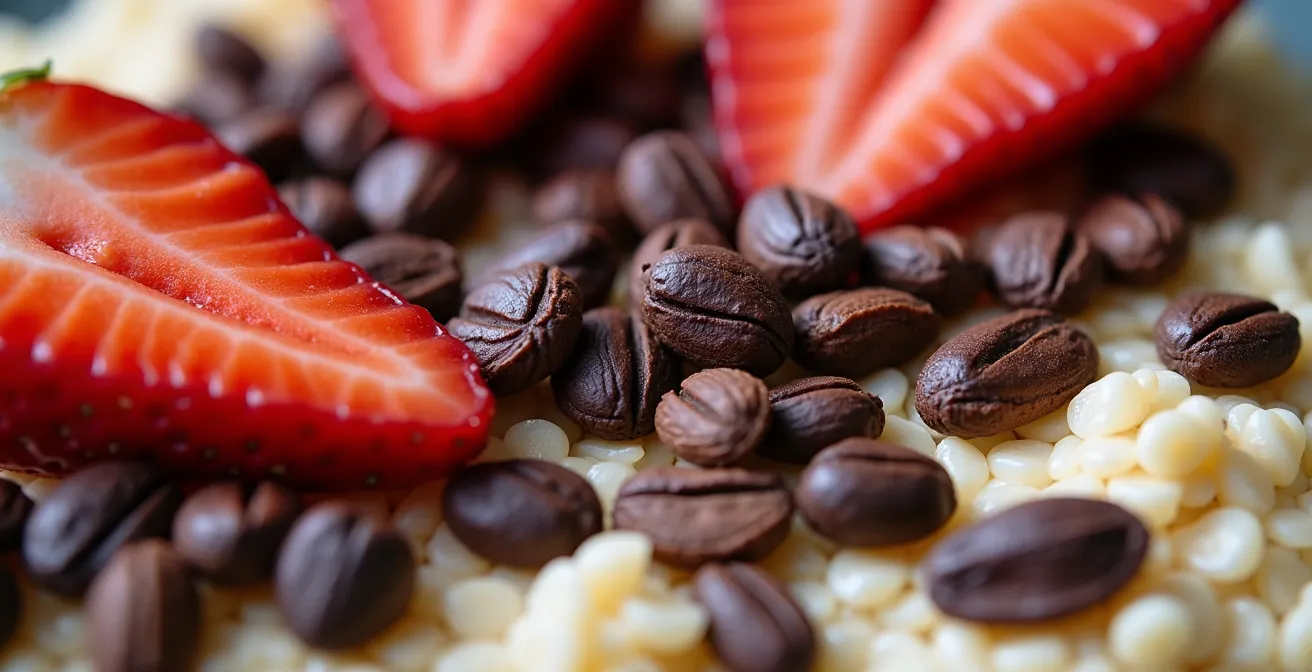
Alternatively, if you prefer a more integrated, melted-chocolate flavor throughout your breakfast, you can stir the nibs in during the last minute of cooking. This will soften them slightly and allow some of the cocoa butter to melt into the oatmeal, infusing it with a rich, chocolatey taste while still retaining some textural variation. For a nutritional bonus, consider pairing your cacao-nib-topped oatmeal with a source of Vitamin C, like a handful of strawberries or a squeeze of orange juice. Vitamin C has been shown to significantly enhance the body’s absorption of the plant-based iron found in cacao, turning your delicious breakfast into a true nutritional powerhouse.
How Small Can a ‘Bite-Sized’ Treat Be Before It Feels Stingy?
The concept of a “bite-sized” treat often feels like a cruel joke on a diet. How can a tiny piece of anything be truly satisfying? The secret lies in shifting the focus from physical volume to sensory density. A treat’s ability to satisfy you is not solely dependent on its size or calorie count, but on the intensity of its flavor, its texture, and the time it takes you to consume it. This is where high-quality dark chocolate shines. A small, 5-gram piece of 90% dark chocolate can be far more satisfying than a 10-gram piece of 70% chocolate, because its intense, complex flavor and slow melt-time command more of your sensory attention.
While general recommendations suggest that 1-2 squares (around 10-20g) of dark chocolate per day is a reasonable amount for a balanced diet, the *perception* of that portion is what truly matters. Instead of just eating the square, the key is to engage in mindful consumption. By breaking a single square into even smaller “micro-bites” and allowing each one to melt slowly on your tongue, you extend the experience. This slow-melt process coats your palate more thoroughly, sending prolonged satisfaction signals to your brain. You are maximizing the “melt-time” and flavor experience from a minimal amount.
This principle was highlighted in research on chocolate consumption patterns. A study found that participants reported greater satisfaction from smaller, high-cacao chocolate pieces eaten mindfully compared to larger pieces eaten quickly. The key factor was the extended “melt-time,” which created a perception of abundance and richness despite the smaller physical size. The portion feels generous not because of its dimensions, but because of the duration and intensity of the pleasure it provides. A 10-gram square might disappear in 30 seconds, but if you take 3 minutes to savor it, you’ve created an experience that feels far more substantial and rewarding, effectively eliminating any feeling of stinginess.
How to Spot Hidden Sugars in ‘Healthy’ Dark Chocolate Bars?
The health halo around dark chocolate has led to an explosion of products on the market, but not all bars are created equal. Many brands market their products as “healthy” while packing them with almost as much sugar as a standard candy bar. For a weight watcher, learning to read the nutrition label and ingredient list is a non-negotiable skill. It empowers you to see past the clever marketing and make a truly informed choice, ensuring your treat is a functional food, not a disguised dessert.
The first and most important clue is the ingredient list. Ingredients are listed by weight, so if sugar (or one of its many aliases) appears as the first or second ingredient, you should be skeptical. This is a strong indicator that the bar’s primary purpose is sweetness, not delivering the benefits of cacao. True dark chocolate should always have a cocoa-derived ingredient (like cocoa mass, cocoa solids, or chocolate liquor) listed first. You also need to be a detective for sugar aliases. Terms like “evaporated cane juice,” “coconut palm sugar,” “agave nectar,” or “malt syrup” are all forms of added sugar.
Another powerful metric is the fiber-to-sugar ratio. High-quality dark chocolate is a good source of fiber. A great rule of thumb is to look for a bar that contains more grams of fiber than grams of sugar per serving. This simple check can quickly help you differentiate a genuinely healthy option from a candy bar in disguise. Finally, don’t be fooled by “sugar-free” labels, as these products often contain artificial sweeteners or sugar alcohols that can cause digestive distress for some people and may not help in retraining your palate to appreciate less sweetness.
Your Action Plan: The 5-Point Sugar Detection Checklist
- Check Ingredient Order: If sugar is listed in the first two ingredients, put the bar back. It’s candy, not health food.
- Hunt for Sugar Aliases: Scan the list for hidden sugars like cane juice, agave, coconut sugar, or malt syrup.
- Calculate the Fiber-to-Sugar Ratio: Ensure there are more grams of fiber than grams of sugar per serving.
- Verify Cocoa Percentage: Look for a bar with a minimum of 70% cocoa solids to ensure you’re getting the benefits.
- Scan for Artificial Sweeteners: Be cautious with “sugar-free” claims and check for ingredients like maltitol, sucralose, or aspartame.
Using this checklist every time you shop turns you into a confident, empowered consumer. You’ll no longer be a victim of misleading marketing, but an expert at choosing a dark chocolate that truly aligns with your health goals.
Key Takeaways
- Mindset over Moderation: Success comes from changing your psychological approach (eliminating the “forbidden fruit” mentality), not just enforcing rigid portion control.
- Function over Flavor Alone: Choose chocolate treats that also provide a functional benefit, such as sustained energy from protein and fiber (nuts) or minerals (cacao nibs).
- Variety is the Spice of Satisfaction: Actively rotate your chocolate choices to combat hedonic adaptation and keep satisfaction levels high with smaller portions.
The ’20-Minute Rule’ That Helps You Stop Eating Sweets at the Right Time
One of the biggest challenges when enjoying a treat is knowing when to stop. You finish your planned portion, but the desire for “just one more bite” is strong. This is often because your brain hasn’t yet received the signal that your body is satisfied. There’s a significant time lag between when your stomach is full and when the satiety hormones signal your brain to stop feeling hungry. This is where the ’20-Minute Rule’ becomes an invaluable tool for mindful eating and portion control.
The rule is simple in principle: after you finish your planned portion of a treat, wait a full 20 minutes before deciding if you truly want more. This isn’t about deprivation; it’s about giving your body’s natural feedback system time to work. In that 20-minute window, a cascade of physiological processes occurs. Hormones like cholecystokinin (CCK) are released from your gut, traveling to your brain to register fullness and satisfaction. By pausing, you allow these signals to catch up with your initial impulse to eat more.
To implement this rule effectively, create a small ritual around it. After you’ve mindfully savored your square of dark chocolate, get up and change your environment. Go for a short walk, put on some music, or have a glass of water or a cup of herbal tea. This physical and mental separation breaks the pattern of mindless eating. More often than not, by the time the 20 minutes are up, you’ll find that the intense craving has subsided. You’ll realize you were satisfied all along; your brain just needed a moment to get the message. This simple pause is a powerful act of self-coaching, helping you distinguish between true hunger and habitual or emotional eating, and putting you firmly back in control.
Frequently Asked Questions About Integrating Dark Chocolate
When should I add cacao nibs for maximum crunch?
For maximum crunch, you should add cacao nibs as a topping after your oatmeal or yogurt is fully prepared. Adding them at the end preserves their delightful crunchy texture and also helps protect their heat-sensitive polyphenols, which are beneficial antioxidants, from degrading under heat.
What if I prefer a melted chocolate flavor throughout?
If you desire a more integrated, rich cocoa flavor, stir the cacao nibs into your oatmeal during the final minute of cooking. This allows the cocoa fats to melt and infuse the entire dish with a melted-chocolate taste while still maintaining some of the nibs’ satisfying textural variation.
How can I maximize nutrient absorption from cacao nibs?
To enhance the absorption of the plant-based iron found in cacao, pair your nibs with a source of vitamin C. Simply adding fresh strawberries, a few orange segments, or even a small splash of orange juice to your oatmeal or snack can significantly increase how much of this important mineral your body absorbs.